Customized On-site Food Safety Training In MN

On-site Food Safety Training in MN

Not all restaurants, food production facilities and institutional kitchens produce the same product in the same way, so why should all food safety certification training take place in a location that doesn’t resemble your facility? We think there numerous advantages to scheduling an on-site food safety training class that takes place at your operation.

Customized On-site Food Safety Training In MN
Image credit: PIRO4D via Pixabay

The Advantages of On-site Food Safety Training

Right off the top of our head, we can think of several benefits to scheduling an instructor led food training session at your facility:

  • Convenience
  • Certifying and training multiple staff members
  • Ability to ask questions relevant to your business
  • Training tailored to your needs

What can be easier than having your instructor come to you? You don’t have to worry about your GPS sending you to North Dakota when you’re searching for a training location you’ve never visited or finding parking near the training facility. It also makes it possible to train and certify multiple employees without worrying about scheduling conflicts or whether or not your employees have access to reliable transportation to the testing location.

A highly knowledgeable food safety expert knows the Minnesota food code in and out, and during a training session at your food production facility you’ll not only have the ability to have your questions answered, but you’ll have the advantage of having your instructor being able to give you real world answers that pertain to your facility and the type of food you produce. A school cafeteria has different needs than a restaurant and there are many different types of kitchens that have different food safety risks. Your instructor can take a look at your facility and answer questions accordingly.

Finally, you can choose which food safety training certification standard you want your employees to achieve. You may want your employees to receive ServSafe training, HAACP certification or any other MN accepted testing, but times and location for your preferred classes just don’t work. Having an on-site training session with all members of your staff that require a certain type of training solves this dilemma

Would you be interested in an on-site food safety training and exam session at your establishment? Let us know, and we’d be happy to design a course that suits your needs.

E.coli in Raw Flour

Food Safety Managers and E.coli in Raw Flour

It’s easy to identify the most common causes of foodborne illnesses; Undercooked proteins, ready-to-eat items contaminated by unwashed hands and produce that contacts pathogens in the dirt. Lately, we’ve noticed an increase in recalls and reports of illnesses caused by E.coli in raw flour. We’d like to take a look at the hazards of raw flour and how you can prevent contaminated product from sickening your guests.

E.coli in Raw Flour
Image credit: PXhere.com

Raw Flour and E.coli

Raw flour isn’t exactly something that appears on everyday menus. In fact, we’ve never been to a restaurant where the wait staff has asked if we’d like to order a side of raw flour while we wait for our meal. If that ever does happen, we’ll take some time to question the chef’s qualifications before proceeding with our order.

Raw flour is, however, an ingredient in many different types of foods. Food service professionals use it in bread doughs, desserts, breading for fried foods and as thickening agents in soups and sauces. So how can we prevent E.coli that may exist in raw flour products from reaching our guests? Here’s a few tips:

  • Treat raw flour and products with raw flour ingredients as a high-risk food
  • Always sanitize preparation surfaces raw flour has contacted
  • Wash all utensils that contact raw flour before reusing
  • Fully cook products with flour ingredients to kill bacteria
  • Monitor recall notices for flour contamination

Food safety managers need to alert staff that E.coli in raw flour can sicken guests. Review cross contamination guidelines and remind employees that just like raw chicken, allowing prepared food to contact raw flour can potentially spread pathogens to your guests. Most products with flour ingredients are cooked well enough to kill E.coli. Just remember, do not undercook foods with flour ingredients.

Finally, remember that flour is a common allergen and can sicken your guests even if it does not contain the dangerous E.coli bacteria. You may wish to include a disclaimer on your menus and packaging that your products either contain or may have come into contact with wheat flour during preparation.

Do you know of any other under-the-radar food that could sicken guests that we should investigate?

Certified Food Managers Foodborne Illness Statistics

Certified Food Managers Guide to Foodborne Illness Statistics

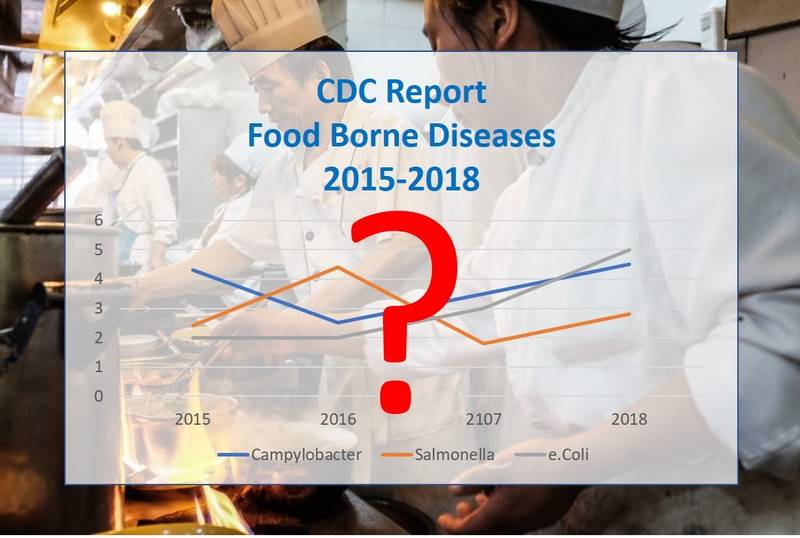
Gathering information on foodborne illness outbreaks gives us a greater insight into how these events start and what measures can be taken to prevent them in the future. The Center for Disease Control recently released a report outlining foodborne illness statistics and discussing testing and observation steps taken during outbreaks in 2018.

Certified Food Managers Foodborne Illness Statistics

CDC Report on Common Pathogens Causing Foodborne Illness

If you’ve taken a quick glance at this report, you may notice some very scientific language and a lot of statistics, so we’ll briefly break down some of the interesting facts in the report in simpler terms.

The bulk of this report discusses enteric infections, or food poisoning cases that affect the intestines. The two largest culprits discussed are campylobacter and salmonella infections. The CDC has confirmed nearly 10,000 infections of each in 2018. Following these two, e.Coli clocks in with nearly 3,000 cases, many of these coming from multiple outbreaks involving tainted romaine lettuce. This registers a 26-percent increase when compared to cases in 2015 to 2017.

Reading some of the discussions in this report indicate that the confirmed numbers are up partly due to improved testing methods. The CDC has increased the use culture-independent diagnostic tests, or CDITs, to diagnose suspected cases of enteric infections. This test is capable of identifying certain pathogens not routinely picked up by previously used testing methods.

While this report does have food-safety implications on a grand scale, what exactly does it mean to certified food managers?

We’ve drawn two conclusions from this report. First, improvements in testing technology show that illness from contaminated food is a larger issue than previous statistics have shown. This means that we should be more diligent then ever in promoting food safety in our establishments.

Finally, these advanced testing techniques have given us the most common pathogens and the food items that most commonly spread the infection. Seeing that there are targets the CDC has identified for improved food safety techniques gives us an insight into what types of ingredients require extra care. Certified food managers can be equipped with the knowledge that certain products are historically more susceptible than others and be diligent in inspecting shipments and following up on recalls and alerts concerning contaminated product.

Do statistics released by the CDC, USDA and other organizations have any effect on you handle food safety for susceptible products?

Certified Food Protection Manager

Minnesota Certified Food Protection Manager Training Options

The state of Minnesota requires most businesses that handle food to have a certified food protection manager(CFPM) on staff. There is no one-size-fits all solution, so this week, we’d like to take a look at what types of training options are available to become a MN Certified Food Protection Manager.

Certified Food Protection Manager
Tim Niles Lead Instructor For Safe Food Training

Qualifying Certified Food Protection Manager Training Programs

There are two ways to gain proper certification to become a certified food protection manager. You can take a course led by an instructor where you have the ability to ask questions, and discuss issues with a leading professional in the industry or you can choose an online version of the course.

There are advantages and disadvantages to either choice. Online food safety training offers convenience taking the training when and where you want, but deprives the student of the ability to participate in discussions with fellow food service professionals and ask questions concerning the material. Instructor led courses as well as all certification testing must be taken at the locations and times scheduled, so there is less flexibility in the timing of the training.

There are also a couple programs that you can choose from. You can take a standard certified food protection manager course which meets the requirements of the state of Minnesota and Wisconsin, or if you wish further education on food safety, you may elect to take the nationally and internationally recognized HAACP training. HAACP provides education targeting the identification and management of food safety risks.

Finally, certification must be renewed every three years. Recertification must occur within six months of the expiration date of your current certification. Recertification requires a minimum of four hours of approved continuing education but does not require you to retake the exam. Most CFPMs retake the standard training once again as a refresher. As with the initial certification training, the recertification can be done either on-line or at one of the scheduled instructor led courses.

Do you or any of your staff need food safety certification? At Safe Food Training, we offer instructor led and online food safety certification classes and exams. We can help with HAACP or even design a specialized class to meet the needs of your business.