How MN Food Manager Lookup Tools Can Help With Record Keeping

MN Food Manager Lookup Tools

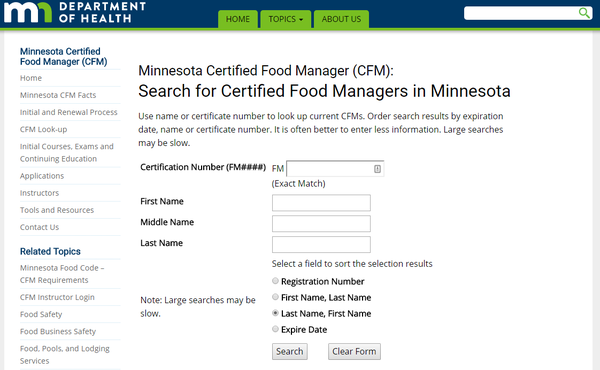
Whether you’re an HR coordinator who hires and maintains records for multiple food production facilities or the owner of a small restaurant, it is sometimes hard to track food manager certification expiration dates or make sure that the new candidate for a supervisor position has the proper certificate for the job. Fortunately, the Minnesota Department of Health provides a handy resource that allows you to verify this information without having the physical paperwork in front of you.

MN Food Manager Lookup Tools

Uses for MN Food Manager Lookup

This tool can be invaluable during the hiring and interviewing process. If a job candidate’s resume shows that they already have the necessary certificate, you can make sure that is correct in a manner of minutes. It also helps you find out if your new hire needs his MN food manager certification renewed before he steps into the position. Just as a side note, hiring courtesy suggests that you inform applicants that you may be checking to see if their paperwork is in order.

This MN food manager lookup effectively assists you in managing your records if you have multiple outlets requiring a certified food manager. While the physical paperwork resides at the facility where the supervisor is stationed, records may also be kept elsewhere. If your business employs multiple certified managers, this resource will help you make sure that everyone’s paperwork is up to date according to state standards.

Finally, you should be aware that the Department of Health’s MN food manager lookup tool is not a substitute for properly posting your food manager certification on-site. The health inspector needs to be able to see it easily when they come for an inspection.

Hopefully, you find this resource useful. If you have any other tools you use to keep your records current, feel free to let us know in the comments section below.

Food Manager Course Guide to Foreign Objects in Prepared Foods

Food Manager Course Guide to Foreign Objects in Prepared Foods

Occasionally, a news story breaks about a recall for foreign objects in pre-packaged foods. For the most part, the contaminating object breaks off of production equipment or comes from an employee, but recently a producer voluntarily recalled packages of frozen hash browns for containing parts of golf balls. We’re not sure if the company shared packaging facilities with a sporting goods store or if the potato farm doubled as a driving range, but we’re sure that strict oversight and review of food manager course guidelines may have prevented this situation.

Food Manager Course Guide to Foreign Objects in Prepared Foods
Copyright: joophoek / 123RF Stock Photo

Preventing Outside Contaminates in Packaged Food Products

If you’re a certified food manager that oversees a production facility, you need to review your procedures from time to time. Hopefully, your staff understands that items such as golf balls don’t have a place on the production floor, but it may be a good idea to take the time to remind your team about what belongs in your production facility and what does not.

We suggest that you train your team to keep any objects that do not relate to their duties away from preparation areas. Here are a few tips to prevent unnecessary contaminates from ending up in your product:

  • Provide lockers for employees’ personal items
  • Keep uniforms simple without buttons and removable badges
  • Frequently inspect equipment for loose or broken parts

Most cases of foreign items causing food hazards arise from negligence or a lack of control over what is brought to the production floor. If you have a safe place for employees to store personal items such as keys, loose change and sporting goods, there will be less chance of these items falling out of their pockets and into your food. Keeping employee lockers away from the production floor will further decrease the odds that foreign objects will end up of food packages.

Broken and worn out equipment is also a likely culprit when it comes to non-food ingredients falling into packaged foods. Inspect your equipment on a regular basis to ensure that everything is in good working order. This will not only prevent parts from falling off, but will also alert you to any problems that could eventually shut down production.

While food manager courses can give us the guidelines to

Contaminates in Packaged Food

, our continued diligence and training is important to keep our customers safe. What other steps do you take to keep foreign objects out of your food?

New Year’s Online Food Manager Certification Renewal

New Year’s Online Food Manager Certification Renewal

This month, we celebrated a huge milestone and released our 100th food safety blog. While we could rest on our laurels, we are going to renew our dedication to helping keep the food produced in our state as safe as possible. With the ringing in of the New Year, we resolve to continue providing convenient HACCP online training and certification, informative instructor led classes and pertinent information and food safety tips in our blog. This is also a time for food service workers to reflect on the past year, and prepare to continue in their efforts to keep their guests safe. One way to do that is to make sure that all of your certifications are in order.


Online Food Manager Certification Renewal

For ease of record keeping and in order to stay compliant with the Minnesota food code, a copy of all employees’ food safety certifications should be readily accessible. We also recommend sorting your employee food handler’s licenses by date of expiration, so that you know which employees are due to take a renewal course.

The New Year is the perfect time to remind your staff to take care of their food safety training. January tends to be a slower month for the food industry, so finding the time to schedule classes and examinations is easier when business is slow.

We understand that employees are also brought on at many times of the year, so diligence is necessary year round, but we have heard from food industry managers that training employees in groups rather that one at a time over the course of the year makes for a smoother process. If you have several employees that are due for renewal within a reasonable time frame, it is not uncommon to renew a few employees’ certifications well before the expiration date.

Finally, this is also a good time to make sure that your designated food safety manager has their certifications up to date. There are multiple certifications that the state of Minnesota accepts, and depending on which one your company requires, January is a good time to take an online food manager certification course for:

  • • Certified Food Safety Manager (NRFSP)
  • ServSafe
  • Prometric certified Food Manager
  • Learn2Serve Protection Manager

NRFSP and ServSafe are the two most commonly taken training courses, and we can help tailor a course that specifically addresses your needs whether you require full staff training or simply need a refresher course before taking any renewal exam.

Will FDA Definition of Health change Food Safety Certification?

Recently, the FDA opened a public inquiry requesting comments on how to define the term “healthy” as it relates to the labels on packaged foods. While this appears only to immediately impact the retail sector, any time the FDA changes any regulation the potential exists that the food service industry will see the effects. We do not foresee any upcoming changes to ServSafe or food safety certification requirements, but this looks like an important topic to explore.

FDA Impact of Food safety certification
Image credit: commons.wikimedia.org

FDA Definition of Healthy and Food Safety Certification

The time period to give the FDA your opinion began on September 26th, so we would like to ask a few questions pertaining to this inquiry in case you plan on submitting your opinions.

• Should a government agency define healthy?
• Should the public define healthy?
• Is there one definition of healthy that works for all consumers?

It is not our intent to influence your opinion on what the FDA’s role is when it comes to the diet of consumers in our country, but we do think we should consider whether or not the FDA is responsible for deciding what healthy means. We all know that the FDA enforces and maintains regulations that keep our food supply safe from natural and man-made hazards, but does a food’s nutritional value fall under their department’s jurisdiction?

On the other hand, does the general populace have all of the information necessary to determine if a food is “healthy”? Even many experts disagree on which types of foods have health benefits and how much of each nutrient we need to consume. We all like to think that we know what is best for us, but how does product labeling influence our food choice decisions?

Finally, can we simply put the entire population in a box and tell them what is healthy for some is healthy for all. The FDA’s inquiry resulted from a complaint that foods rich in certain fats that have health benefits for some consumers are refused the “healthy” label. There may be questions as to whether refusing the “healthy” label to all foods that contain fats will prevent consumers from purchasing items that contain certain elements that may actually have nutritional value.

These are only a few of the questions that we have come up with that should be considered. If you’d like to submit your opinion, the FDA is currently accepting your comments on the topic of how to define “healthy” as a food label until January 26, 2017. We would also like to know how you feel about this topic so please leave your input in the comments section below.