Hand Sanitizer and Safe Food Handling Practices

Hand Sanitizer and Safe Food Handling Practices

During online food safety courses, students learn that hand washing prevents the spread of food-borne illness. From time to time, a student asks what role hand sanitizers play in killing bacteria, and if hand sanitizer benefits food service workers.

Hand Sanitizer and Safe Food Handling Practices
Image credit: Wikimedia Commons

Safe Food Handling Practices and Hand Sanitizers

The Minnesota Department of Health allows for hand sanitizer use in food production facilities. However, hand sanitizers must not replace proper hand washing in any situation. Effective hand sanitizers kill viruses and bacteria, but only hand washing removes dirt, grime and grease from underneath fingernails or the natural crevices in human skin. Just to review the safe food handling practices, proper hand washing involves:

  • Washing under hot water
  • The use of plenty of soap
  • Scrubbing for at least 20 seconds

If the Department of Health rules state that all food service workers must wash their hands after handling raw meat, using the bathroom or doing anything that contaminates their hands, when can a hand sanitizer be used?

If you feel the need to use a hand sanitizer to kill bacteria, you must wash your hands immediately after use and before handling food. Washing your hands after using a sanitizer will not negate the virus killing effects. In fact, washing your hands removes fragrances and other chemicals that exist in commercially produced hand sanitizers than could make your guests sick.

Finally, the food code allows hand sanitizers in situations where product is not handled by hand. This occurs in retail or grocery situations where food product is sealed or in instances where utensils are the only means of food handling.

The use of hand sanitizers is only one of many concerns that many professionals ask for clarification on food code regulations. If you have any other situations you’d like us to cover, please leave a question in the comments section below.

How to Become Food Safety Certified in MN

In a recent article, we covered what types of businesses need to be aware of food manager certification rules in Minnesota. If you have opened a new food business or read our blog and discovered that you need to have an employee certified, we’re ready to let you know how to go about the process of being compliant with state regulations.
MN Food Safety Certified

How to Become Food Safety Certified

You first need to decide which employee to designate as your food manager. You should select your kitchen manager, head chef or floor manager. Whoever you choose, they must be a full-time employee who controls food preparation at your outlet.

You must next select which certification your manager will obtain. The state of Minnesota accepts the following courses:

    • ServSafe
    • Certified Food Safety Manager
    • Certified Professional Food Manager
    • Learn2Serve Food Protection Manager

Before signing up for any classes or certification exams, check with the owner of your business to see if they require specific training courses. Many national and regional chains restrict which certifications they like their managers to obtain.

Many of these classes and food safety certification exams can be taken online or in instructor-led sessions. While online classes offer convenience, in-person training gives students the opportunity to engage with an instructor and have questions answered right away.

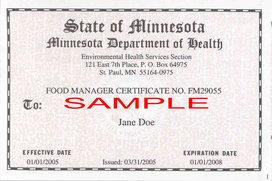
Finally, apply for the correct paperwork with the health department. It is not enough to pass an online food manager certificate exam. You must apply for certification with the state. The Minnesota Department of Health provides access to these applications online.

Once you receive your certification from the proper authorities, you must post it in a visible and easily accessible location.

Whether you are a first time manager or you need to renew your food manager certification, we can help provide the proper class for any jurisdiction in Minnesota. If you have any questions about certification that we did not cover or would like to know how to become food safety certified, please visit our homepage for more information.

Food Safe Training and Menu Design

Food Safe Training and Menu Design

After a long day of teaching food safe training classes and helping food service professionals obtain their food safety certification, we like to visit the local restaurants that many of our students represent. We often notice is that many of the restaurants we eat at seem to have incredible menu designs while others could use an adjustment or two to make them more presentable to their guests.

Food Safe Training and Menu Design
Image credit Yay Images

Food Safe Training and Menu Design

Menus not only let your guests know what dishes you offer, they have the potential to tell the story of your restaurant. We feel that a well-designed menu is like a well written novel. Your menu can display your personality, intrigue your diners and help you build a reputation. Here are some tips that we hope you find helpful when designing your next menu:

• Be clear but concise
• Be true to your theme
• Avoid clutter
• Have defined dish types

We have seen some menus that take meandering steps to describe each dish. That can confuse diners and cause them to scan over items with long descriptions. If you own a book store café or some other themed restaurant, you may take liberties here to fit your restaurant’s theme, but in many cases you will be best served to utilize simple descriptions. Many fine dining restaurants even skip the descriptions and simply list key components.

You also need to remember that it is important to be true to what you envision your theme to be. Use fonts, layouts and backgrounds that identify with your décor or the style of cuisine that you serve.

Finally, we’ve stepped into restaurants after a food safe training class and have been handed a convoluted menu with very little rhyme or reason. The fonts were elegant, the menu looked classy, but it took a while to find the type of dish that we were looking for. To avoid a cluttered menu, make sure that you group like items together. Have a section of burgers, maybe organize by food types, or even separate your dishes by the type of proteins involved. However you organize your menu, make sure that you take the time to assess whether or not it is organized in a logical and readable manner.

On a final note, with so many guests suffering from allergies and having special dietary needs, we suggest you consider finding a way to alert your guests if any item contains common allergens. We find it also helpful to see menus that identify vegetarian, vegan and gluten free options, and remember, if you serve any dishes that contain undercooked proteins or eggs, you must include a disclaimer somewhere on your menu.

Seasonal Staff and Food Safety Certification MN Requirements

Seasonal Staff and Food Safety Certification MN Requirement Training


Many restaurants and food-production facilities will take on seasonal help to assist with higher volume during the busy summer season and to account for full-time employees’ vacation requests. With so many incoming part-time staff, there are difficulties when it comes time to take care of training, orientation and food safety certification MN requirements. At Safe Food Training, we have a few tips to help transition your seasonal staff into your regular staff efficiently so that you will lose as little time as possible bringing them up to speed.

Integrating Seasonal Staff into Your Operation

From what we have heard during our interactions with local food industry professionals, we have encountered three common problems that are inherent in hiring seasonal workers.


  • Making sure each new hire understands company policies
  • Training new employees efficiently
  • Getting each new employee the proper food safety certification MN requirements

Many companies forgo a formal orientation session for their seasonal workers. They feel that paying them to attend an orientation seminar is unnecessary since they may only be around for a small amount of time. We disagree. We think that it is important to have everyone on the same page as far as knowing what your facility’s operating procedures are. Taking care of this in one session where all of your seasonal help is in attendance will save valuable time rather than explaining each rule as workplace situations arise.


The opposite may be true when it comes to training your new hires. Many people are hands-on learners or hands-on teachers. The nature of the food industry requires some hands-on learning in order to understand how to get things done right. Breaking down your seasonal hires into smaller groups, or even setting up one-on-one training sessions will get them up to speed much faster than large on-the-job training groups.


Finally, you will have to make sure that all of your seasonal hires have the proper food handler permits and food safety certification MN requirements. When it comes to ensuring that all of your new employees have the necessary certifications, Safe Food Training is more than happy to help. We can set up group training sessions at your restaurant, hotel or any other type of food preparation facility. We can take into account the specific nature of your business and develop a food safety certification MN course that directly addresses the unique needs of your company’s operations.


Are you a food-production business that finds it necessary to take on several seasonal staff members during the summer months? If you have any tips for your fellow food-industry professionals to help smooth the process of integrating your temporary employees, please leave them in the comments below.