
Foodborne Illness Cases Are Spiking: What MN Managers Need to Know

person throwing up

In the pa

deli meat foodborne illness
Are you updated on all recalls?

The Bottom Line 

Recent data show a 25% increase in foodborne illness cases across the U.S., driven largely by high-profile outbreaks involving Listeria and Salmonella. For Minnesota food managers, this surge underscores a critical reality: trust in the supply chain is not enough. Rigorous internal protocols, specifically temperature control and supplier verification, are your kitchen’s only true defense against contaminated product.

The Surge: Recent Outbreaks You Can't Ignore

In the past year, we have witnessed a troubling rise in large-scale recalls. These aren’t just minor isolated incidents; they are systemic failures affecting millions of pounds of product.

Three Major Cases Every Manager Should Know:

person throwing up
Know the recalls and help prevent illness.


  • Boar’s Head (Listeria): After a liverwurst sample tested positive for Listeria, authorities triggered a massive recall of over 7 million pounds of deli meats and poultry. This outbreak led to hospitalizations across multiple states, underscoring that even “ready-to-eat” foods pose a significant risk.

  • Lyons ReadyCare (Listeria): Frozen supplemental shakes served in healthcare settings were linked to 12 deaths and 38 infections. This tragedy emphasizes the vulnerability of high-risk populations (like nursing home residents) to foodborne pathogens.

  • Raw Farm LLC (Salmonella): An ongoing outbreak linked to raw milk products has sickened at least 165 individuals since 2023. This case serves as a stark reminder of the dangers inherent in unpasteurized dairy.

By the Numbers: Why Risk Is Rising

The statistics are alarming. In 2024 alone, reported foodborne illnesses jumped by 25% compared to the previous year.

man in hospital
Prevent foodborne illnesses by keeping a close eye on recalls!
  • Illnesses: 1,392 reported cases.

  • Hospitalizations: More than doubled (rising from 230 to 487).

  • Deaths: Increased from 8 to 19.

Why is this happening?


Experts point to a mix of infrastructural issues, regulatory gaps, and staffing shortages in inspection agencies. In short, the safety net is strained, meaning the last check often falls on you, the kitchen manager.

Manager Takeaway: The "Jeff Factor"

In my years of teaching, I have seen recalls come and go, but the numbers we are seeing now are different. When the supply chain falters, your kitchen protocols must be airtight.

Here is what you need to do tomorrow:

FDA
The FDA and USDA list recalls on their websites.


  1. Check Your Recalls: Don’t wait for a letter. actively check the FDA/USDA recall lists weekly.

  2. Verify Suppliers: If you are sourcing specialty products (like raw milk or local meats), ensure they have rigorous testing in place.

  3. Refresher Training: Remind staff that “pre-cooked” or “deli” doesn’t mean “risk-free.” Cross-contamination at the slicer can turn a single contaminated loaf into a widespread outbreak.

Frequently Asked Questions (FAQ)

Common questions I get include:

How can I stay updated on food recalls in Minnesota?

The most reliable sources are the FDA Recall List and the Minnesota Department of Health website. We also include major alerts in our Safe Food Training newsletters.

Does washing deli meat kill Listeria?

165 thermometer temp
Know the temperature that kills pathogens and bacteria.

No, you can only kill Listeria by cooking it to 165°F. Washing meat creates a cross-contamination risk by splashing bacteria onto sinks and countertops.

Why are illnesses increasing even with more regulations?

Regulations exist, but there are not enough enforcement resources. Additionally, our food supply chain is more complex than ever, meaning a single contamination event at a large facility (like Boar’s Head) can instantly affect distribution nationwide.

Why Trust Safe Food Training?

Building on a 20-Year Legacy of Food Safety Excellence.

Safe Food Training has been a cornerstone of Minnesota’s food safety community for over two decades. While ownership transitioned to Jeff Webster in 2025, our mission remains unchanged: to provide the highest standard of education to the state’s food professionals.

  • Proven Track Record: We have helped thousands of managers earn their certifications.

  • Local Focus: We understand Minnesota-specific codes and challenges.

  • Flexible Learning: From the Twin Cities to Duluth, Alexandria, and Brainerd, we bring the classroom to you.

Need to renew your certification?


View our upcoming course schedule!

WHY MN FOOD CODE REQUIRES RAW EGGS TO BE REFRIGERATED?

Why MN Food Code Requires Raw Eggs to be Refrigerated

In every restaurant and nearly every home in the United States, raw eggs are stored under refrigeration at 40 degrees Fahrenheit or lower. According to the MN food code and food safety training courses, refrigerating raw eggs prevents Salmonella. Salmonella is a food-borne gastrointestinal illness that affects a reported 42,000 Americans each year. This number is certainly higher due to many mild cases which go unreported. Businesses that sell or cook eggs for public consumption must refrigerate them in an effort to prevent outbreaks of this type of foodborne illness.

Why MN Food Code Requires Raw Eggs to be Refrigerated
Image credit: enginakyurt via 123rf

Why The United Kingdom Does Not Refrigerate Raw Eggs

Many travelers to the United Kingdom, and many other parts of the world, often notice that people do not refrigerate raw eggs and store them at room temperature most often. This has puzzled many individuals who were taught that eggs should always be refrigerated. The answer to this question lies in a brief explanation of the differences in egg production and distribution between the United States and Great Britain.

The different philosophy of egg storage between the two countries is due to the difference in production standards. In the United States, farmers wash and sanitize eggs post-harvest. Correspondingly, Great Britain’s regulations dictate that eggs must remain dry throughout production and distribution. Rinsing eggs destroys the thin natural protective layer, known as the cuticle, which can prevent contaminants from entering the egg.

In the United Kingdom, a majority of egg producers vaccinate their egg-laying hens in an effort to prevent disease. Here in the United States, we use this process minimally.

According to an article written for www.foodsafetynews.com, these practices have “reduced the incidence of Salmonella illnesses in Britain from 14,771 reported cases in 1997 to 581 cases in 2009.” The entire foodsafeteynews.com article can be found here.

MN Food Code Approach To Serving Raw Eggs

In order to complete food manager certification in MN, knowledge of preventing food-borne illness is a must. Salmonella is a common food-borne illness that can potentially be deadly but is also easily preventable. There are a few MN food code statutes to keep in mind when dealing with raw eggs that can prevent the spread of this illness.

  • Refrigerate eggs using temperatures below 40 degrees Fahrenheit,
  • Throw away broken eggs to avoid contamination easily
  • Clean dirty eggs before use
  • When you need a large quantity, use pasteurized liquid eggs instead of raw shell eggs

The two MN food code statutes that pertain to eggs appear:

Certified Food Managers Guide to Foodborne Illness Statistics

Certified Food Managers Foodborne Illness Statistics

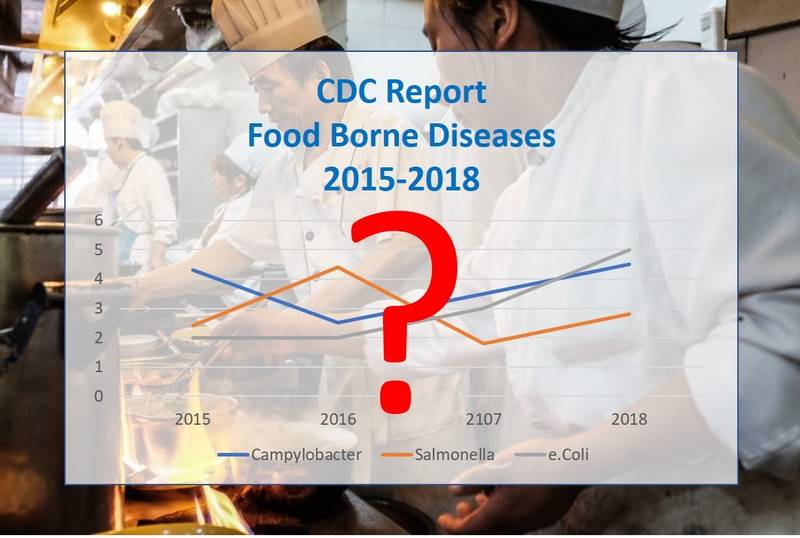
Gathering information on foodborne illness outbreaks gives us a greater insight into how these events start and what measures can be taken to prevent them in the future. The Center for Disease Control recently released a report outlining foodborne illness statistics and discussing testing and observation steps taken during outbreaks in 2018.

Certified Food Managers Foodborne Illness Statistics

CDC Report on Common Pathogens Causing Foodborne Illness

If you’ve taken a quick glance at this report, you may notice some very scientific language and a lot of statistics, so we’ll briefly break down some of the interesting facts in the report in simpler terms.

The bulk of this report discusses enteric infections, or food poisoning cases that affect the intestines. The two largest culprits discussed are campylobacter and salmonella infections. The CDC has confirmed nearly 10,000 infections of each in 2018. Following these two, e.Coli clocks in with nearly 3,000 cases, many of these coming from multiple outbreaks involving tainted romaine lettuce. This registers a 26-percent increase when compared to cases in 2015 to 2017.

Reading some of the discussions in this report indicate that the confirmed numbers are up partly due to improved testing methods. The CDC has increased the use culture-independent diagnostic tests, or CDITs, to diagnose suspected cases of enteric infections. This test is capable of identifying certain pathogens not routinely picked up by previously used testing methods.

While this report does have food-safety implications on a grand scale, what exactly does it mean to certified food managers?

We’ve drawn two conclusions from this report. First, improvements in testing technology show that illness from contaminated food is a larger issue than previous statistics have shown. This means that we should be more diligent then ever in promoting food safety in our establishments.

Finally, these advanced testing techniques have given us the most common pathogens and the food items that most commonly spread the infection. Seeing that there are targets the CDC has identified for improved food safety techniques gives us an insight into what types of ingredients require extra care. Certified food managers can be equipped with the knowledge that certain products are historically more susceptible than others and be diligent in inspecting shipments and following up on recalls and alerts concerning contaminated product.

Do statistics released by the CDC, USDA and other organizations have any effect on you handle food safety for susceptible products?

Safe Food Training for Seafood-Salmonella

Seafood-Salmonella

Recently a Seafood- Salmonella outbreak has prompted the recall of frozen, raw, canned tuna. At last count, the outbreak has sickened at least 13 people, including one in the state of Minnesota. Raw canned seafood is popular in restaurants that feature raw dishes such as sushi, sashimi and ceviche. Salmonella is usually associated with undercooked eggs, chicken and produce from farms that use chicken manure as fertilizer, but this case shows that the danger of food poisoning from unlikely sources is a real risk and requires some extra food safety training for Seafood-Salmonella.

Image credit: Petr Kratochvil via PublicDomainPictures.net

Seafood-Salmonella from Contaminated Ingredients

The only sure-fire way to eliminate salmonella is through heating proteins to proper cooking temperatures, so what can food safety managers do about salmonella that shows up in raw or undercooked foods?

First, follow news stories such as this and pay attention to the FDA’s recall list. For your convenience, we also have a handy widget posted on the right side of our blog page that you can check out while you read this article. Keeping up to date on these types of news stories and recalls is vital if you serve sensitive products such as sushi, sashimi or other raw and undercooked products.

Once you’ve been alerted to these Seafood-Salmonella stories, check your inventory immediately to determine if your stock contains potentially contaminated product. In the case of canned seafood, these recalls usually include batch numbers which are printed on every can. If you have the same brand of canned seafood or a different product from the same manufacturer, but the batch numbers do not match, don’t just assume your product is safe to serve. Do a little more research into the recall or call your local health inspector to verify the extent of contaminated items.

Since many of these factors are out of the control of food service protection managers and cannot be countered by even the most rigid food safety training, be proactive if one of your guests is sickened by these types of products. Record batch numbers and work with your health inspector to determine whether or not your guest was sickened by tainted product or some other factor. If you do have such an incident, do not attempt to serve the same product to any other guests. It’s never safe to assume a food-poisoning case is an isolated incident.

Do you serve raw seafood in your restaurant? If so, do you prefer fresh fish or canned and frozen product?