A New Look At Food Product Recalls for Certified Food Protection Managers

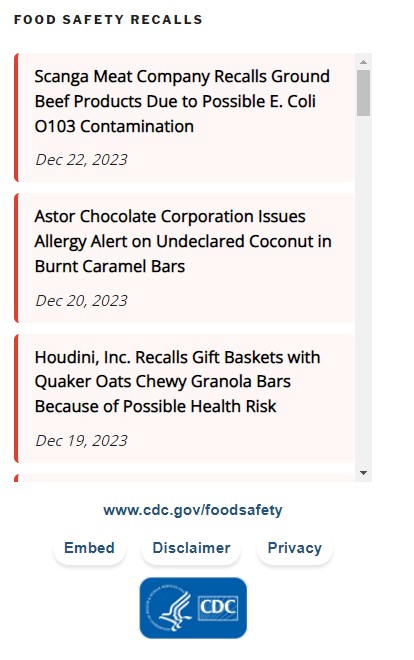
Food Product Recall Widget For Certified Food Protection Managers

In the very first “Safe Food for Thought”, a blog for certified food protection managers, published on October 30, 2015, we discussed the importance of keeping up to date on food product recalls. As part of that new platform, we included a US foodsafety.gov fed streaming Food recall alert. This feature provides real-time notices of recalls and public health alerts from the U.S. Department of Agriculture (USDA) and the U.S. Food and Drug Administration (FDA), which are listed in the widget 24/7.

You no longer have to lose sleep worrying about serving contaminated food supplied by a manufacturer. Instead, quickly check the widget on our blog once daily to ensure your supplies are safe.

Food Product Recall Widget For Certified Food Protection Managers

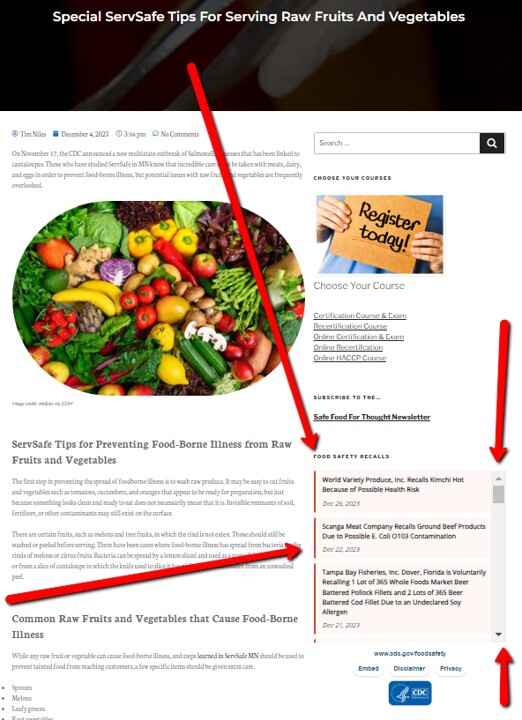
On full screen, you will see the Food Safety Recall widget on the right side of our blog page. A slide bar on the right allows you to scroll down to see recalls past recalls. If you find a recall that concerns you, click on it, and you’ll get detailed information. (You must scroll past the most recent blogs on your mobile to find the widget.)

Indeed, paying attention to product recalls is crucial, but it’s equally important to know what constitutes a recalled item. Food product recalls are incredibly specific. Questionable products in your inventory must have all of these details:

  • Same brand
  • Product name
  • Use-by or freeze-by date
  • Establishment number
  • And more.

If you’re unsure, your certified food protection manager can always contact the manufacturer with your information and ask if they recalled the food product.

If the product details match, please follow these steps:

  • Do not open or consume the product!
  • Contact your supplier to return the product or dispose of it according to the instructions in the recall notice. This is vital as it ensures no one else could pick it up and consume it.

By all means, keep yourself and those around you safe by staying informed on recalls and taking proper actions when necessary.

How often do you actively check your inventory products for recalls?

New MN Food Safety Certification Guidelines On Avian Influenza

MN Food Safety Certification Guidelines On Avian Influenza

Just as it appeared to fade into oblivion, we get another reminder that Avian Influenza is still a health concern in the world and also in Minnesota. A recent article goes into detail on why we should still keep up our guard and a USDA study released  March of 2023 indicates Minnesota is the hot spot of the country for Avion flu. CFPM classes don’t always cover Avion flu, so providing food safety guidelines for it is crucial.

MN Food Safety Certification Guidelines On Avian Influenza
Image credit : USDA

MN Food Safety Certification Guidelines On Avian Influenza That Will Protect Your Customers

One of the best places to start to answer the question as to whether the “bird flu” can affect guests who have consumed tainted poultry is to look at the FDA’s take on the subject.

To give you a quick summary, Avian Influenza cannot be spread by consuming properly cooked turkey, chicken, duck or eggs. The most common transfer of bird flu is strictly from bird to bird contact in close quarters. It is possible for the disease to transfer to humans, but only in rare cases where the infected person has come into direct and constant contact with infected birds or their feces.

Even though there is very little chance of passing Avian Influenza on to your customers via prepared food, they will inevitably have their concerns. Here are a few tips on dealing with poultry and alleviating your guests’ qualms concerning the bird flu.

MN Food Safety Certification Guidelines On Bird flu
  • Always cook poultry to an internal temperature of 165 degrees
  • Wash all surfaces that have come into contact with raw and cooked meat products after use
  • Always cook eggs until whites and yolks are firm
  • If a recipe calls for undercooked eggs or more than three whole eggs substitute pasteurized eggs for raw shell eggs

These four MN food safety certification guidelines should always be taken under every circumstance. Even without the threat of Avian Influenza, but under the circumstances, reminding your staff about proper poultry handling can help alleviate contamination concerns.

The frequency of scares involving our food sources has risen over the past decade. We’d like to know how you educate your staff and customers on MN food safety guidelines to keep food safe when a new scare arises?

Simplified Reasons For MN Certified Food Protection Manager Training

MN certified food protection manager CFPM

Minnesota law requires most food establishments to employ a Certified Food Protection Manager (CFPM) to prevent foodborne illness and ensure public safety. Safe Food Training offers both personalized 8-hour initial certification courses and 4-hour continuing education renewals to help you meet these state standards. Whether you choose our 

distraction-free in-person classes or flexible online options, we ensure your MN food license remains compliant.

What are the worst messages you could get when opening your kitchen for the Thursday lunch shift? You could be dealing with a broken walk-in cooler or a supplier who shorted your produce order. But the absolute worst message is multiple customers calling to report they’re doing the “Pepto Bismol dance” after eating your Wednesday daily special.

Beyond the immediate panic and guilt, a single foodborne illness incident can devastate your business’s reputation. To prevent these embarrassing and costly situations, the Minnesota Department of Health (MDH) and the Minnesota Department of Agriculture (MDA) mandate that most food establishments employ a Certified Food Protection Manager (CFPM).

The Real Cost of Food Safety Lapses

illness reporting in MN
Do you know the rules for illness reporting?

Food safety isn’t just about passing your routine health inspection; it’s about protecting your community and your financial investment. In a recent study by the USDA Economic Research Service, the total cost of the leading U.S. foodborne illnesses was estimated at over $17.6 billion annually.


For a local Minnesota business—whether you’re running a busy diner in St. Paul or a school cafeteria in Duluth—the costs of an outbreak include:

  • Severe Revenue Loss: A “closed by health department” sign stops traffic instantly, and bad online reviews linger for years.
  • Legal and Insurance Costs: Potential lawsuits from affected customers will immediately spike your liability insurance premiums.
  • Licensing Risks: Failure to have a CFPM on staff can result in state-issued citations, fines, or a complete license suspension.

Minnesota CFPM Requirements at a Glance

certification
Choose how you learn best.

Navigating state regulations doesn’t have to be a headache. Here’s exactly what Minnesota requires for your certification:


Requirement

Details

Initial Certification

Must complete an approved 8-hour course and pass an accredited exam.

Renewal Cycle

Your Minnesota CFPM certificate expires every three years.

Continuing Education

4 hours of approved continuing education (CE) training is required for renewal prior to expiration.

State Registry Application

After passing your exam or completing CE, you must submit an application and fee to the MN Department of Health to get your official state certificate.

The "Choice" Narrative: In-Person vs. Online Training

At Safe Food Training, we know that food safety shouldn’t be a generic, one-size-fits-all experience. Restaurant managers have different learning styles and schedules, which is why we emphasize your choice in how you train.

The In-Person Advantage: We highly recommend our in-person training. Stepping out of your restaurant into a distraction-free environment drastically increases your focus and your exam pass rate. It allows for direct interaction, letting you ask specific questions about cooling a 5-gallon batch of chili or calibrating bimetallic stemmed thermometers.

The Online Flexibility: If you’re managing multiple locations or simply can’t leave the kitchen for a full day, our online training options provide the critical flexibility you need to learn on your own schedule while still meeting state requirements.

The Backend is Serious Business

Designers set the mood in the front of the house with lighting, furniture, and music. But the back of the house is serious business. Led by Jeff Webster, Safe Food Training brings years of real-world industry experience to the classroom. We cover vital, tangible best practices, including:

Training for you and your team-salad prep
Training for you and your team.
  • Temperature Control: Mastering the “Danger Zone” and Safe Cooling Parameters.
  • Cross-Contamination: Strict protocols for separating raw poultry from ready-to-eat foods during prep.
  • Employee Hygiene: Enforcing strict handwashing and health reporting policies for sick employees.

Requiring your kitchen managers to get and maintain their food safety certification is one of the best investments an owner can make.

Frequently Asked Questions (Q&A)

Navigating state regulations can sometimes feel overwhelming, so I’ve put together answers to some of the most common questions we get from Minnesota kitchen managers.

Q: How often must I complete continuing education to maintain my food safety certification in Minnesota?

A: In Minnesota, you must renew your certified food protection manager license by completing 4 hours of continuing education every three years.

Q: How will I know when it's time to renew my certification?

A: As a valued client of Safe Food Training, you don’t have to worry about tracking your renewal date. We provide timely reminders for the three-year renewal cycle to ensure you complete your required continuing education before your certification expires.

Q: I just need continuing education credits. Do I have to take the full 8-hour course?

A: No, you don’t. We offer dedicated continuing education training specifically for professionals who need to fulfill Minnesota’s renewal requirements.

Q: What happens if I don't pass the Certified Food Protection Manager exam on my first attempt?

A: We’re dedicated to your success. If you don’t pass the exam on your first try, we offer a retake of the course and exam at one of our regularly scheduled sessions.

Q: What does "personalized training" actually mean?

A: We focus on creating a convenient and effective learning experience that fits your specific needs. Led by Jeff Webster, we discuss the food safety challenges relevant to your unique operation—whether you’re in a school cafeteria, a large restaurant, or a catering business.

Protect Your Kitchen, Protect Your Business

commercial kitchen
Sign up for the next available class today!

Don’t leave your restaurant’s reputation to chance or wait until a health inspector knocks on your door to check your credentials. Whether you need your initial certification or it’s simply time for your three-year renewal, we’re here to make the process straightforward and stress-free.

Ready to secure your Minnesota food license? Register for an upcoming course today!

African Swine Fever and Future Food Safety Concerns

Future Food Safety Concerns

We like to keep certified food protection managers informed on a wide range of issues concerning food safety, including future food safety concerns and potential threats government agencies are watching. This week, we’d like to take a close look at a situation in Asia that has the USDA on heightened alert for a situation that could have drastic impacts on our country’s pork supply.

Future Food Safety Concerns
Image Credit: Channel NewsAsia

How African Swine Fever Impacts Future Food Safety Concerns in the US

A recent discovery and seizure of illegal Chinese pork products has prevented a potential risk of African swine fever from reaching our shores.

The good news is, that there are no recorded cases of African swine fever in the United States, but with cases spreading throughout Asia, the risk becomes greater with every outbreak that this disease will someday reach our shores.

It is unclear what dangers ASF presents to humans. It can however kill a pig within a day. This could be disastrous and cause many pork products to become scarce, expensive and pose a threat to food safety. The USDA is taking this potential threat so seriously that they are recommending international travelers avoid visiting petting zoos and farms with pigs during their travels.

Most food suppliers source pork from the U.S. and reliably inspected international sources, however, it may be a good idea to keep an eye on where your product comes from. Make sure that you use pork products that come from a source you trust that has passed USDA standards.

While this threat has yet to reach our shores, it’s worth keeping an eye on. Would you really want to live in a world without bacon?