Proposed Changes In The MN Food Code Will Effect Kitchen Equipment Requirements

Proposed Changes In The MN Food Code Will Effect Kitchen Equipment

In the coming months, the Minnesota Department of Health will be making some changes to the current food code. One of those changes deals with the types of certifications equipment in industrial kitchens must have. This week, we’ll take a look at how changes in the MN food code will effect kitchen equipment decisions and how it impacts certified food managers in Minnesota.
Proposed Changes In The MN Food Code Will Effect Kitchen Equipment
Image credit: American National Standards Institute

New Changes In The MN Food Code Will Effect Kitchen Equipment Choices

According to the new regulations, MN certified food managers will have much more freedom as to what equipment they use in their establishment. There will no longer be the requirement for all equipment to be NSF (National Sanitation Foundation) certified. This does not mean that anything goes when it comes to your equipment; certain equipment will still need to be certified for sanitation by an ANSI (American National Certification Institute) certification program. These 10 types of equipment still require sanitation certification:

  • Warewashing Sinks
  • Mechanical Warewashing Equipment
  • Mechanical Refrigeration Units
  • Walk-in Freezers
  • Hot-Holding Equipment
  • Cooking Equipment other than Microwaves and Toasters
  • Ice Machines
  • Mechanical Slicers
  • Mechanical Tenderizers and Grinders
  • Food Preparation Surfaces, including Prep Sinks

So, how does a certified food manager know whether or not their equipment is certified by the proper agency? Most industrial kitchen equipment will have a stamp, label or other markings indicating that it has been classified for sanitation. If you have a piece of equipment that is listed above without any visible markings, contacting the product manufacturer or your local health department’s office may help you find the necessary information.

With these upcoming changes to equipment sanitation classifications, now may be a good time for certified food managers to make a quick inspection of all of the equipment on the list to ensure they have the proper certification. We feel that widening the scope to any ANSI sanitation standard gives food production facilities more flexibility when it comes to equipment choices. How do you feel about changes in the MN food code will effect kitchen equipment? Will it mean more freedom or more burden?
New Certified Food Protection Manager Vomit Cleanup Regulations

Certified Food Protection Manager Vomit Cleanup

Vomit and feces cleanup may not be a subject that most people want to talk about, but it’s an important topic for food safety managers to understand. The Minnesota Food Code will soon be changing, and among those changes are new procedures for cleaning up vomit and feces after an incident. We’ll explore Certified Food Protection Manager Vomit Cleanup Guidelines.

Certified Food Protection Manager Vomit Cleanup

Image credit: C Tennie via Wikimedia Commons

Certified Food Protection Manager Vomit Cleanup Guidelines

Hopefully it’s not a common occurrence, but there may be an incident that requires a food safety manager to monitor or perform the cleanup of vomit or diarrhea in their facility. The new language in the food code states that food safety managers must establish procedures for employees to follow in the event of a vomit or diarrhea incident. These procedures should be well defined and understood by all members of your staff. Your established procedures should look something like this:

  • Act fast
  • Wear gloves
  • Contain the contamination
  • Properly clean and sanitize the affected area
  • Thoroughly wash contaminated plateware and utensils
  • Properly wash your hands after cleaning up

Containing the incident right way stops the spread of particles that could end up in a guest’s food. Allowing vomit or feces to remain where it is for any length of time gives bacteria ample opportunity to multiply and spread to other sections of your facility.

Wearing rubber gloves, preferable elbow length gloves, will prevent any fecal matter or vomit from touching an employee’s skin. Wearing protective gloves, make sure every surface has been cleaned from visible matter, and then sanitize. Just because there are no visible signs of bacteria, it doesn’t mean that all traces have been removed. Liberally sanitize the areas where the incident occurred, and make sure to extend your sanitation range well beyond the location where visible contaminates are located. Invisible bacteria can be ejected quite a distance from the affected area.

Finally, dispose of any soiled items that are not salvageable and wash all linens, plates, cups and any other utensils in the affected area. Be safe and wash everything within a decent radius of the incident. The possibility remains that unseen bacteria has contaminated nearby utensils.

Do you already have a Certified Food Protection Manager Vomit Cleanup procedure posted for employees?

New Food Safety Training for Reusable Takeout Containers

Food Safety Training for Reusable Takeout Containers

Over the past few months, we’ve been covering upcoming changes to the Minnesota Food Code, and in the course of our research, we’ve come across a proposed rule that allows food outlets to utilize reusable takeout containers for food and beverages. Since these containers are not always stored on site, adapting to this new opportunity will take a quick food safety training for reusable takeout containers. A simple procedure adjustment that will assure your product can be delivered in reusable containers with minimized risk of spreading food-borne illness.

Food Safety Training for Reusable Takeout Containers
Image credit: webstaurantstore.com

A New Guide to Food Safety Training for Reusable Takeout Containers

A reusable take-home container prevents wasted paper products, and potentially reduces supply costs for food service providers. If you plan on supplying reusable takeout containers to your customers, you should follow these guidelines in the food code.

  • Use  only containers designed and constructed for reuse
  • Takeout containers must be initially provided by the food establishment
  • You must always clean, sanitize and inspect for food particles before refilling

Your local food service provider or restaurant supply store should have plenty of options for refillable containers that meet the health department’s criteria. It’s important to note that guests cannot bring a container from home and ask to have it filled with food. These containers must initially come from your facility. This provides two opportunities for business owners. First, it allows you to ensure that the container is safe for food. If you know where the container comes from it will be greatly reduce your risk. Secondly, marketing opportunities abound if you supply custom containers with your business’ logo and contact information. Having a refillable container that reminds customers of your establishment generates more revenue from return visits.

Always clean, sanitize and inspect  returned containers at your facility. Also note, a guest cannot fill a reusable food container. The code requires an employee of the establishment fill the take-home food receptacle.  Guests may fill beverage containers, however, if there is a contamination-free transfer process.

Considering the potential to reduce waste and packaging cost along with the branding/customer loyalty possibilities; will you provide your team with food safety training for reusable takeout containers and try this new takeout option once the rules take effect?

Minnesota Food Code Changes for Warewashing Water Temperature

warewashing water temperature

Dishwashing machines are a vital part of any food service operation, but they also present a potential food safety hazard if not maintained properly. One key part of any dishwashing machines ability to sanitize plateware, silverware and cooking utensils is having hot water available, and with new changes coming to the Minnesota food code, you’ll soon be required to take specific steps to monitor the warewashing water temperature in your dishwashing machine.

warewashing water temperature
Image Credit: ThermoWorks

Proposed Minnesota Food Code Compatible Warewashing Water Temperature Measuring Options

We learn in online ServSafe courses that the hot water temperature in your dishwashing machine must reach temperatures greater than 160 degrees for proper sanitation. Many types of devices exist that can ensure that food contact surfaces reach the proper temperature:

  • Single-Use Temperature-Sensitive Stickers
  • Temperature-Sensitive Labels and Test Strips
  • Reusable Waterproof Thermometers

Temperature-sensitive stickers and labels are color changing devices that can only be used one time. There are advantages and disadvantages to using stickers and labels. The cost of a box of these temperature-sensitive devices is much cheaper than a thermometer designed for measuring your dishwashing machine’s water temperature. Accuracy of these labels can be called into question as they do not give you a reading to the exact degree. While they do change color based on water temperature, they only give you a range of temperature rather than an exact reading. A word of warning about stickers and labels; they come in many different temperature ranges, so make sure you purchase a product that reads temperatures of at least 160 degrees.

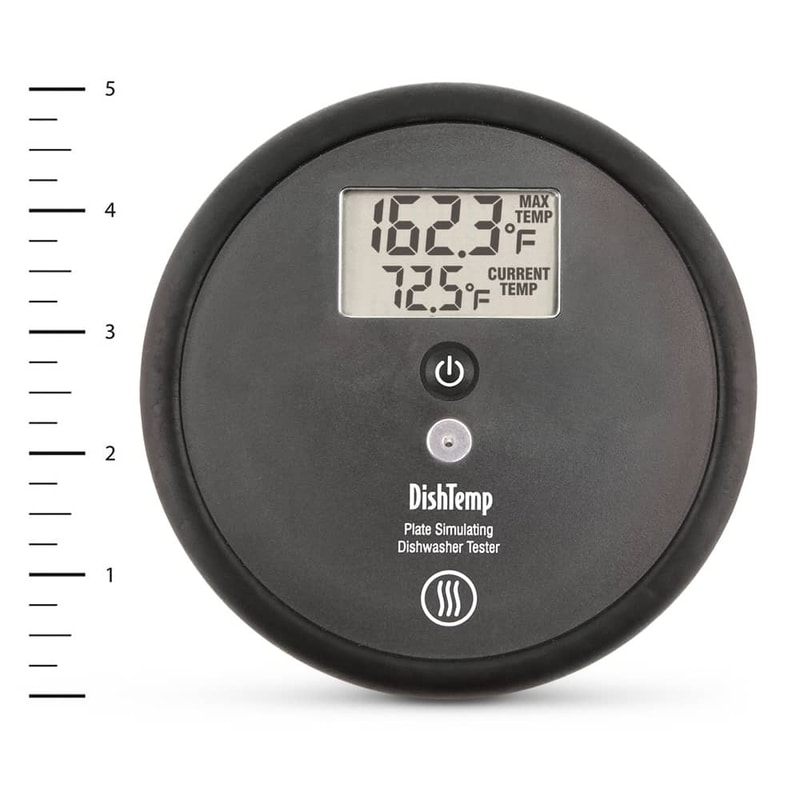
We recommend a reusable Min-Max registering digital thermometer designed for warewashing. While the initial cost of these is much more expensive, over time you may find the long term cost of buying box after box after box of test strips might be more expensive. These thermometers can be accurate to the tenth or hundredth of a degree, and come in numerous styles, some that are even shaped like a small plate that will fit conveniently on your dishwashing rack. They are easy to read, easy to use and give you a much better idea of exactly how your dishwashing machine is performing.

Making sure that your warewashing temperature is high enough to kill pathogens will eliminate one sensitive area in your facility. We’d like to know which type of temperature monitoring device you find the most convenient.