These Post-Holiday Season Slump Secrets Can Help CFPMs

post-holiday season slump secrets can help CFPMs

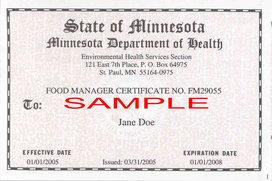
The month of December is traditionally the busiest month of the year in the food service industry. But it’s followed by January, which has the notorious reputation of being the slowest. While at first, the post-holiday season slump is a pleasant break from the non-stop holiday pace, MN certified food protection managers – CFPMs soon begin to scratch their heads to find ways to keep their staff productive and happily employed at the same time.

In some cases, it may be necessary to trim labor hours during the slow season. However, there are ways to take advantage of the downtime.
Post-Holiday Season Slump Secrets Can Help CFPMs

Potential Post-Holiday Season Slump Projects For CFPMs

Before cutting hours or letting your staff set up card games in the break room, there are several tasks that you should consider taking care of when you have a seasonal lull in production.

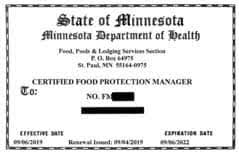
  • Ensure your key managers have up-to-date Minnesota CFPM certification
  • Address potential food safety hazards
  • Clean and organize storage areas
  • Cross-train employees

One of every MN certified food protection manager’s priorities should be to address potential food safety concerns during the post-holiday slump season. That is why January is the perfect month to ensure your staff’s training is current. Instead of taking away valuable production time during the busy months, this slow season is the perfect time for food safety training. It is also a good time to alter and change production methods and organize your storage space to eliminate potential contamination hazards.

Utilizing downtime to cross-train employees is an often overlooked alternative to cutting staff hours. January is a good time of the year to assess your team members for individuals who have the potential to move into other roles within your facility or those who are eager to learn more.

There are slow seasons throughout the year in nearly any industry. Spending your downtime wisely can often prepare your team for success in the new year. The staff at Safe Food Training would like to take this time to wish you a safe, productive, and successful 2024.
It’s Here: The Final CFPM Installment On Under Cooked Proteins

CFPM Installment On Under Cooked Proteins

In the final installment of our series on serving under cooked animal product, we will discuss the protein that is almost always ordered under cooked by CFPMs. Breakfast customers rarely order eggs well done. They are critical elements in many sauces and give custards rich textures. Looking at the Minnesota food code temperature rules, we can see that eggs cooked for hot holding must reach a temperature of 155 degrees for at least 15 seconds. How does this apply to over-easy eggs, Béarnaise sauce, and ice creams where the egg product never reaches 155 degrees?

CFPM Installment On Under Cooked Proteins
Image credit: J. Patrick Fischer via Wikipedia

CFPM and the Ubiquitous Under Cooked Protein- The Egg

If you work in a restaurant or institution that serves breakfast, you will receive numerous orders for eggs that are over-easy, sunny side up, or soft-boiled. These orders will leave the egg below the 145-degree temperature requirement stated in the food code for eggs prepared for immediate consumption. It is perfectly acceptable to cook and immediately serve an over-easy egg to a guest. The key is that they have to serve it immediately after cooking. Hence, you must include a warning if you serve undercooked eggs in your restaurant. “There may be a risk of foodborne illness when certain items are ordered undercooked.”

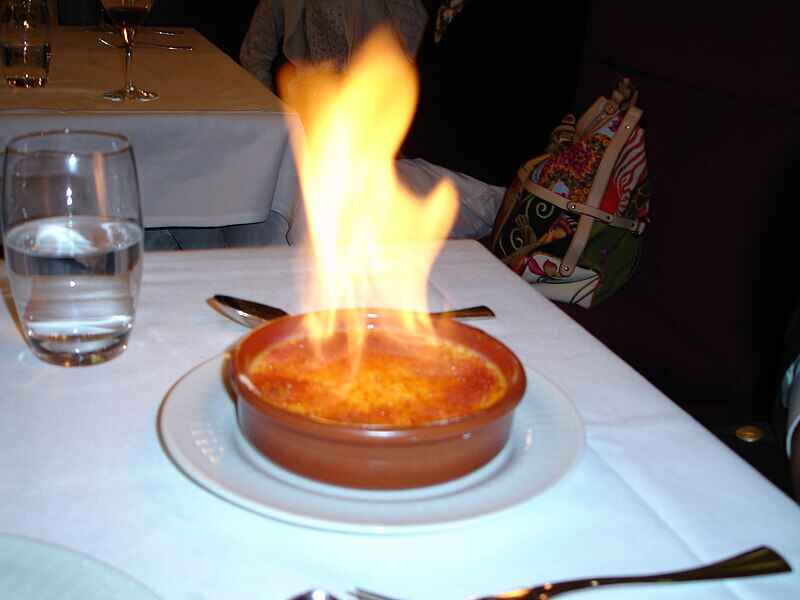
How do these rules apply to products like Hollandaise sauce, crème brulee, or ice cream? These items:

  • have eggs
  • have never reached 155 degrees
  • are not served immediately

The Minnesota food code insists that pasteurized eggs substitute raw eggs. Many chefs argue that liquid pasteurized eggs do not work for particular items. Thanks to modern advancements in sanitation and pasteurization, you can purchase whole, raw, pasteurized shell eggs. Although the liquid form of pasteurized eggs is the most common, your product supplier should have whole, raw pasteurized eggs available.
While discussing raw eggs, let’s take a brief moment to talk about homemade mayonnaise and aioli. These are two egg-based products that have never been cooked. If you serve house-made mayonnaise:

  • only use liquid pasteurized eggs
  • always store it below 41 degrees.

Remember, you should never hold undercooked eggs in a warmer or a steam tray for service.

The Ultimate Food Safety Certification Guide To Controlling Fruit Flies In MN Restaurants

A food safety certification tip- creating a simple trap can be used to catch fruit flies

Fruit flies are one of the most invasive restaurant pests in MN this time of the year. While MN food safety certification training does not specifically cover how to control fruit flies, keeping them out of your facility is an important part of maintaining a clean and safe environment.

Food Safety Certification Guide To Controlling Fruit Flies

Food Safety Certification Guide To Controlling Fruit Flies

Keeping a clean kitchen is an obvious step towards preventing a fruit fly infestation. However, a simple surface clean will not be sufficient to avoid the appearance of fruit flies. A deep clean will be necessary to remove potential fruit fly nesting sites. Hidden breeding grounds often exist under refrigeration units, sinks, and designated preparation areas.

Fruit flies thrive on fruit and vegetable matter. Keeping fruit and vegetables from becoming nesting grounds for these pests is crucial. This is not only for keeping them out of the kitchen but also for food safety. Storing normally shelf-stable produce under refrigeration rather than on counter surfaces will keep your fruits and vegetables out of warmer temperatures. This is important because warmer temperatures are where fruit flies thrive.

Maintaining produce quality for items that are located in dry-storage locations is vitally important. A potato or squash that has begun to rot will not only attract pests. It will become a major breeding ground. This breeding ground has the potential to infest your entire workspace. Keeping your produce areas clean and free of spoiled items will greatly reduce your risk.

Even if you have taken all the necessary steps to prevent fruit flies from finding nesting grounds, they will inevitably make an appearance. The next step is to remove them from your work space.

Fruit fly strips are easily accessible at local hardware stores, but you must exercise caution when using them in food preparation facilities. MN food safety certification training states that all pest control chemicals must be kept away from food. Proper placement for fruit fly strips will be in places such as inside the lids of covered garbage cans, near compost containers and under sinks and other surfaces.

A Simple Homemade Trap

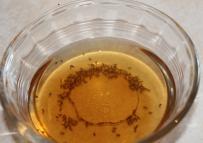
Homemade trap for fruit flies is not part of food safety certification training but it works

For areas where a fruit fly strip will not be an option, such as near food preparation areas and where they will be visible to customers, a rudimentary trap may be an alternative. These can be easily created with a shallow transparent glass or bowl. Fill it with a small amount of apple cider vinegar or orange juice. Then, place a thin film of dish soap on top. Fruit flies will be attracted to the sugar of the vinegar or juice. They will become trapped when the soap prevents them from breathing.

While MN food safety certification training does not outline steps for preventing these invasive pests, such as fruit flies, there are ways to control their presence and provide a safe and healthy food preparation environment.

ServSafe MN Tips for A Bacteria Free Steamer

ServSafe MN Tips for A Bacteria Free Steamer

The industrial steamer has become a vital tool in many kitchens. It streamlines production and takes the place of makeshift steamer pans on your range or flat-top grill. There are risks, however, in taking this key piece of equipment for granted. Food-borne illness can arise as a result of lack of maintenance. We will introduce some ServSafe MN tips to keep your steamer safe from harmful bacteria.

ServSafe MN Tips for A Bacteria Free Steamer

Image credit: Photo credit: www.foodservicewarehouse.com

ServSafe MN Guide to a Safe Steamer

Cleanliness plays a crucial role in maintaining the safety of the food that is prepared and reheated in your steamer. Since the steamer uses moisture and heat to cook food without drying it out, it can create a breeding ground for bacteria. Bacteria thrive and multiply in a moist and warm environment. The temperatures inside the steamer stay in the danger zone when it’s not in use.

We want to ensure that you don’t have to constantly worry about the possibility of contamination in your steamed food. To prevent harmful bacteria from contaminating your food, we have some simple tips to share with you.

  • Wipe up spills immediately
  • Clean door seals daily
  • Change the water frequently if you have a connectionless or countertop steamer model

Cleanliness maintains the safety of the food prepared and reheated in your steamer. Since the steamer uses moisture and heat to cook food without drying it out, it can create a breeding ground for bacteria. Bacteria thrive and multiply in a moist and warm environment. The temperatures inside the steamer stay in the danger zone when it’s not in use.

We want to ensure that you don’t have to constantly worry about the possibility of contamination in your steamed food. To prevent harmful bacteria from contaminating your food, we have some simple tips to share with you.

You may be cooking the same thing time and time again, but those spills can find their way into the drainage and steam circulation systems. It’s much easier to clean that up before food remnants find places to hide and begin cultivating potential contaminates.

Another frequent hiding place for bacteria lies in the seals of the steamer door. To prevent contaminating particles from festering, it’s important to wipe down and sanitize these on a daily basis.

Steamers Not Connected to Your Water System

Our third item applies to steamers that are not connected to your facility’s water system. Table top models with water drawers take a little more care when it comes to daily maintenance. Your staff must frequently check the water levels and change the water supply regularly to prevent the formation of bacteria in the reserve tank.

There are also a few ServSafe MN concerns that you should be aware of when using an industrial steamer. We will fully cover that issue in few weeks, when our blog will be discussing burn and scald prevention, as well as how to respond to burn accidents when they occur.

Every MN food manager’s approach to their equipment is different. At Safe Food Training, we’d like to know how you use the steamer in your facility. Is it an essential part of your operation, or is it something that is rarely used?