Special Conflict Management Best Practices For Certified Food Managers

Special Conflict Management Best Practices For Certified Food Managers

While you always strive for harmony in the workplace, every once in a while as a manager you will have to deal with employee conflict. This week we’d like to take a look at conflict management in the work place, and how certified food managers can deal with issues as they arise.

Special Conflict Management Best Practices For Certified Food Managers

Copyright: photosvit via 123rf

How a MN Certified Food Protection Manager Deals with Conflict

It’s impossible to completely eliminate employee conflict, especially in stressful environments such as the food industry, but with the right approach a certified food manager can build a staff that not only gets along but enjoys working together. Talking with human resource managers and food service supervisors, we’ve come up with a few common themes concerning conflict resolution.

  • Prevent conflict before it starts
  • Don’t let conflict fester
  • Involve your HR representative

Our first tip may be hard to do sometimes, but there are ways certified food managers can prevent conflicts from occurring. Many conflicts in the workplace arise from individuals’ dissatisfaction with their roles. If a role does not satisfy an employee, they may direct their frustrations towards their fellow employees. If you can identify individuals who are unhappy with their role, you may be able to give them an opportunity express their frustrations to you before they take it out on their coworkers.

The food industry is a stressful place by nature. Another way certified food managers can manage conflict is to keep morale high. This can vary from facility to facility, but there are ways to keep morale high under stressful circumstances. Some ways include social interactions, such as organizing company events that do not involve job duties, or making sure employees can take regular breaks.

Know When To Intervene

Even with the highest morale, it is inevitable that conflict will arise. These are times when a CFPM must decide whether to address the issue or let your employees work things out for themselves. It’s not necessary to intervene in every circumstance, but you must use your best discretion. If there is a conflict that you feel will be detrimental to your operation, you need to address it. Sometimes, letting your staff work things out for themselves will lead to further problems. If there are situations which you feel that you’re unable to handle, it may be necessary to bring in a representative from human resources that has been trained to resolve employee conflict.

We know that there is no cut and dry solution to resolving conflicts among your staff, so we’d like you to leave us a comment as to how you deal with these situations.

Practical Advice For The Newly Promoted Food Manager

Practical Advice For The Newly Promoted Food Manager

Congratulations! You’ve put in your time. You’ve worked your hardest. Now you’ve been rewarded by being promoted to supervisor at your establishment. Your first order of business is to get your MN food manager certification online. Then you’ll be officially ready to take over.

Tips for the Newly Promoted Food Manager

Once the excitement dies down from gaining your first food management position dies down, it will be inevitable that you’ll feel some anxiety during the transition. We have a few suggestions that may help you settle into your recently gained role and responsibilities.

Our first suggestion is to consider that, since this is your first management position. It may not be wise to implement changes right away. Hopefully, your company already has a system in place to assist your food production in continuing to run smoothly and effectively during the transition. It would be acceptable to make adjustments to certain procedures where you see room for improvement. However, completely overhauling the way things operate should not be one of your initial objectives.

Practical Advice For The Newly Promoted Food Manager

Image credit: bowie15 via 123rf

Once you begin your new food manager duties, it’s important to find a comfortable management style. Many newly promoted managers often make the mistake of attempting to run their facility with an authoritarian style. When you assume your new role, it’s important to remember that you can lead your staff by working with them rather than attempting to manage every aspect of their jobs. Most employees perform better when they feel that they are trusted. There are also dangers if you choose to be too lax once you take over your supervisory role. Allowing your staff too much freedom can lead to production problems and the neglect of proper procedure. Our advice is to work closely with your staff and assess who is trustworthy and who needs more supervision.

Mold Your Operation To Reflect Your Managerial Style

As we advised earlier, it may not be appropriate to make huge changes as soon as you assume your new food manager role. However, once you have fully learned the current procedures and regulations and have become a leader of your staff, the time may be right. You can begin molding your operation to reflect your managerial style. When making changes, we suggest you always consult with whoever you report to before proceeding. You may have earned their trust enough to gain your position. However, they may not be comfortable if you make major changes to the way their business works without their consent.

We hear many stories from experienced professionals about their first supervisor job. We’re wondering if any of those seasoned veterans want to share some advice for those who are just now beginning their careers as a certified food manager.

Timely Hints On Food Storage For Food Safety Certification

Timely hints on food Storage For Food Safety Certification

Proper storage of all types of food products, whether raw meats, dairy, produce or fully prepared foods, is essential in any branch of the food service industry. Improperly stored food can lead to loss of profits due to waste, food-borne illness due to cross contamination and wasted time while employees search for product. This post provides timely hints on food storage regulations that go beyond food safety certification.

Timely Hints On Food Storage For Food Safety Certification

Image credit: National Center for Environmental Health

Food Safety Certification MN Tips On Meat Storage

Meat storage tends to be the most misunderstood and poorly implemented procedure when it comes to food storage. Raw meat should always be stored below cooked product, but food safety certification MN states that raw meats should be kept separate during storage and production. One way to ensure the safe storage of raw products and prevent cross contamination is by storing products with lower cooking temperatures on higher shelves than those with higher temperatures. The properly organized refrigerator should look like this in descending order if you store raw meats on the same rack.

  • Raw steaks and full cuts of beef (145 degrees minimum)
  • Raw ground beef (155 degrees)
  • Raw poultry (165 degrees)

You will notice that we have not included seafood on our list. Even though seafood has a minimum cooking temperature of 145 degrees, we recommend separating it further from all other product. We feel that this is an important food safety certification precaution for food storage to protect those who have allergies to seafood and shellfish.

The optimal way to achieve proper storage is to have dedicated areas for meat, dairy, and produce. Larger outlets such as large-scale food manufacturing plants can easily achieve this by using multiple refrigeration units. Many restaurants, hotels, and smaller institutional facilities do not have this luxury, so diligence is important.

Tips for Streamlining Food Storage

The first tip food safety certification to ensure proper food storage is to label everything. Food labeling and dating should occur when received or prepared. This is the obvious first step, and is required to know for food safety certification in MN, but it is helpful to take labeling one step further than minimum requirements.

Label the sections, shelves and empty spaces in your refrigerators. Employees will be able to see the designated storage location for each type of product. It will also prevent the confusion of a storage system that constantly changes.

Another tip is to store produce and meat as far away from each other as possible. In many cases, this can be achieved by splitting refrigeration space in half. One side of a walk-in refrigerator will contain produce, the other meat products. Two separate refrigerators would be the ideal storage solution, but this is not always achievable. In cramped quarters, the labeling of all available space will streamline your storage process.

Proper food storage appears simple on paper, but implementing an organized system is well worth the vigilance.

Helpful Tips For Food Managers On Sanitation Of The Overlooked Ice Machine

ice machine sanitation

As one of the many dedicated certified food managers in Minnesota, you devote countless hours to training your staff on the critical points of food safety. You drill them on handling raw proteins, maintaining the cold chain, and cooking foods to precise temperatures. Yet, a universal ingredient, one that cools drinks and preserves buffet displays, often gets overlooked: ice. Proper ice machine sanitation is not a minor detail—it’s a fundamental component of a safe kitchen that every food manager should regularly review with their team.

The Hidden Risks: Why Ice Is a Food

ice machine sanitation
Ice is food. Learn about Ice Machine Maintenance.

It’s easy to forget, but the Food and Drug Administration (FDA) officially classifies ice as food. This means it is subject to the same strict handling and sanitation requirements as any other ready-to-eat product. When standards slip, the dark, damp interior of an ice machine becomes a perfect breeding ground for bacteria, biofilm, and mold. The problem isn’t just theoretical.

  • Health Hazards: Contaminated ice can introduce harmful pathogens, such as norovirus and E. coli, to your customers, leading to serious foodborne illness outbreaks.

  • Allergen Concerns: Mold spores that proliferate in a poorly maintained machine can trigger allergic reactions or asthma attacks in sensitive individuals.

Compliance Violations: A dirty ice machine is a clear red flag for health inspectors and can cause costly violations that damage your establishment’s reputation.

Lorem ipsum dolor sit amet, consectetur adipiscing elit. Ut elit tellus, luctus nec ullamcorper mattis, pulvinar dapibus leo.

Mastering Proper Handling and Ice Machine Sanitation

Simply having an ice machine doesn’t guarantee the production of safe ice. The daily procedures your kitchen and bar staff follow are critical for preventing cross-contamination. Reinforcing these two key handling protocols is essential for everyday safety.

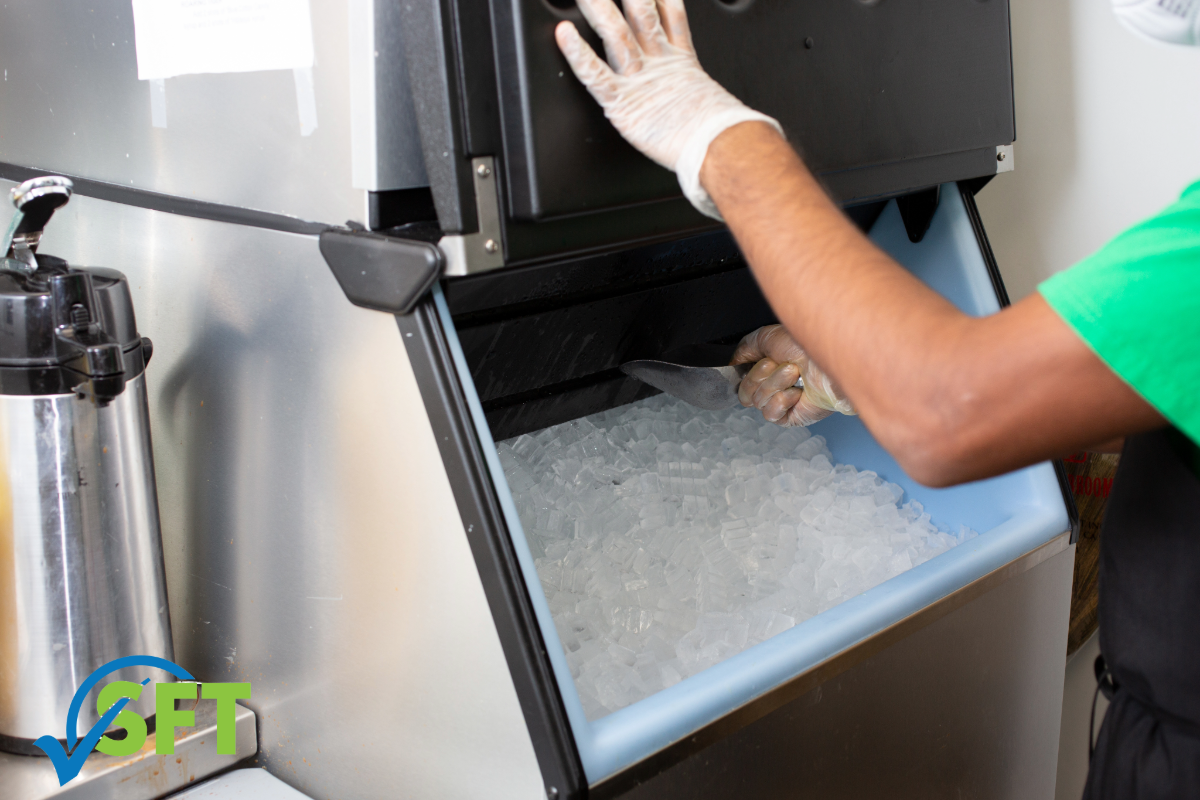
  • Eliminate Bare-Hand Contact: The Minnesota food code clearly states that ready-to-eat foods must not be handled with bare hands. Staff should always use a dedicated, sanitized scoop to retrieve ice. For best practice, wearing single-use gloves adds another layer of protection, preventing hands from inadvertently touching the ice supply, even when using a scoop.

  • Sanitary Scoop Storage: Do not leave an ice scoop on top of the machine, where it can collect dust, or store it inside the ice bin, where the handle can become contaminated. The only acceptable method is to store the scoop in a dedicated, clean, and sanitized container, or on a sanitized tray, ensuring it is not exposed to environmental contaminants between uses.

Maintaining a Clean Zone: Inside and Out

Ice in a drink-Ice machine sanitation
Are you serving safe drinks? Learn about Ice machine sanitation!

The safety of your ice depends on the cleanliness of both the machine’s interior and its surrounding environment. You must treat the ice machine as food-contact equipment and maintain the surrounding area to prevent pests and external contaminants from compromising your ice supply.

  • The machine is for ice only: It may seem convenient, but you should never use the ice bin as a refrigerator to chill canned beverages, bottles of wine, or other food products. The exterior of these containers is not sanitary and will introduce bacteria and dirt directly into your ice.

  • Keep the surrounding area clean: The warmth and moisture from an ice machine’s condenser can create an attractive environment for pests. Clean and remove all debris from the floor and drains under and around the machine. Keep the top of the machine clear and never use it as a storage shelf for boxes, dirty dishes, or other items.

Protecting your customers requires a comprehensive approach to food safety that accounts for every ingredient, including the ice. At Safe Food Training, we focus on the real-world challenges that certified food managers in Minnesota face on a daily basis. Our training goes beyond the basics to cover these often-overlooked hazards that can impact your operation.

Don’t let poor ice machine sanitation undermine your hard work. If you and your team are ready to deepen your understanding of Minnesota’s food safety standards, our expert-led, instructor-led options provide the convenient and comprehensive training you need. 

Visit Safe Food Training today to schedule your next session and ensure your establishment is a model of safety, from the first ingredient to the last ice cube.