The Truth About Custom Food Safety Certification Training

Maple Grove Schools Group Food Safety Certification MN Training

If you’re a restaurateur who owns or manages multiple locations, then you know what a hassle it can be to manage all of the required food safety certifications. In contrast,our trainers make it easy to get all of your team’s certifications/re-certifications up to date. We come to you and deliver a custom group food safety certification training session for all of your employees, and we can administer the testing for new food safety managers who require it.

Maple Grove Schools Group Food Safety Certification MN Training

The Benefits of Custom Group Food Safety Certification Training

By having our trainers come to your facility to provide customized food safety certification training, you can enjoy three significant benefits:

  • Convenience
  • Cost
  • Customizable training

Basically, our on-site options eliminate the need to worry about coordinating the schedules of all staff members who require certification. We are able to work around your unique schedule, ensuring that every staff member that needs certification is able to attend. Additionally, scheduling group training at your restaurant may be more cost-effective. Rather than paying individual fees for each staff member, we are able to offer a group rate that keeps the expense of training all of your staff to a minimum.

Built to Address Your Unique Business Needs

At Safe Food Training MN, we offer customized food safety certification training sessions that are tailored to your unique business needs. Unlike online food safety courses or regularly scheduled classes, our trainers come to your facility and work with you to identify and address any issues specific to your operation. During the training session, we cover unique aspects of your business that are not normally addressed in basic training courses.

Additionally, we can design either a ServSafe or NRFSP training course according to your needs. Then we include any information in your sessions that you feel you or your employees could use more training on. Our knowledgeable trainers will make sure that you’re aware of the most current rules and procedures for any situation.

Our custom food safety certification training sessions are not just for restaurants. We can design a course aimed at:

  • school lunch programs
  • retirement facilities
  • food production outlets
  • or any other type of business that requires unique food safety training in MN

Our training sessions cover unique aspects of your business that are not normally addressed in basic training courses.

Our custom food safety certification training sessions are not just for restaurants. We can design a course aimed at:

  • school lunch programs
  • retirement facilities
  • food production outlets
  • or any other type of business that requires unique food safety training in MN

Our training sessions cover unique aspects of your business that are not normally addressed in basic training courses.

Do Group Training Sessions Work?

Colleen Fairbanks, Lead Food Services Specialist at Osseo Area Schools, had this to say about our group training services: “We had Safe Food Training come in and do our training because they were able to come to us and tailor the training to what our managers needed in order to get their MN food managers license. I would recommend anyone use Safe Food Training because they will tailor the training to what you specifically need in your department.”

A New Look At Delivery Drivers and Food Safety – Part 2

Food Safety Certification MN and Providing Delivery Services

Last month we investigated how food delivery apps work and whether or not they were monitored by your local health department. Following that article, we thought that it would be helpful to provide some food safety information and tips for restaurant outlets that provide their own delivery service to their loyal customers.

Food Safety Certification MN and Providing Delivery Services
Photo credit: www.flickr.com

Food Safety Hints For Providing Delivery Services

This biggest issue with food delivery is that there is a high risk that the food’s temperature will fall into the danger zone. If your product falls between 140 and 40 degrees during delivery, there is a risk of bacteria growth. Many chain restaurants employ the use of insulated containers to keep their food hot during delivery. We strongly urge you to talk to your local culinary supply store about obtaining several of these containers. Before you begin providing delivery to your customers. We also suggest that you consider limiting your delivery range. A smaller delivery area means you can deliver hot food product to your customers in a timely manner.

The rules for keeping cold foods safe for consumption after delivery is more straightforward than those for hot foods. Refrigerated items may go without refrigeration for up to two hours according to the Minnesota Health Code. This means that your salads and sandwiches and other cold items kept in sanitary containers should be safe for delivery. Be aware that raw animal protein items such as sushi are much more sensitive than other cold products. If you are planning on delivering any raw or undercooked proteins. You may wish to consult with your local health inspector.

Non-Food Safety Considerations for Delivery Services

There are other aspects besides food safety that you should plan for if you are considering offering delivery service. Keep in mind that you will need to have additional staff available to provide this service. Be sure to get the right balance of staff to handle the new service. You want to avoid a negative impact on your current services or long waits for delivery. Neither scenario is good for building a satisfied customer base or increasing employee morale on busy evenings. Having an extra hand available on weekends and during peak times will be a key element in helping you offer delivery services to your clientele.

Finally, make sure that your delivery drivers have received food safety training from a certified food protection manager. They are vital members of your team and will be essential in seeing that your product arrives to your customers in a safe-to-eat state.

Are you extending your food services to clients who wish to have their meals delivered? At Safe Food Training, we’d like to know your thoughts on how you plan to keep your meals safe during delivery.

Are Food Charities Actually Required To Employ A Professional CFPM?

CFPM serving Soup at food charity

Over the past few years, there has been an uptick in food charities as the pandemic and other factors have created the need to help those who struggle with hunger and affording proper nutrition. With so many soup kitchen type charities helping fill that need, we’ve been asked if food charities need to have a certified food protection manager – CFPM oversee their operation. There is no cut and dry answer, because there are a lot of variables involved, but if you run a food charity, you may want to consider certified food protection manager training to keep the food you provide safe.

Are Food Charities Actually Required To Employ A Professional CFPM?
Image credit: lucapbl via 123rf

The Benefits of Certified Food Protection Manager Training for Charitable Food Efforts

When talking about certified food protection managers for businesses, most restaurants and food production businesses are required to have one certified food protection manager (CFPM) on staff to ensure that food is prepared in accordance with the Minnesota food code and that all employees are aware of safe food handling procedures. Since charities are not exactly a food businesses, there may be some confusion among volunteer organizations as to whether they should have a member of their volunteer team receive CFPM training.

Whether or not you are required to have a certified food protection manager may be up to your local health department. If you’re simply distributing prepackaged meals or heating ready-to-eat product for instant service, your organization may be considered low-risk and not monitored by the health department. If you are preparing raw products, chilling and reheating items and storing them for later service, you may want to consider certified food protection manager training even if your local health department does not require it. Benefits of CFPM training include:

  • Better Insight into Food Safety
  • Knowledge of How to Store Hot and Cold Foods
  • Confidence that Those You Help Receive Pathogen Free Meals
  • Ability to Oversee Untrained Volunteers

Even if you’re not selling food product, food safety is incredibly important. Knowing how to properly prepare food keeps those you help safe. Most food charity organizations are staffed by volunteers who may have never had any food safety training, so having a CFPM overseer who has been trained will help prevent a lack of knowledge from sickening those you are trying to help.

Do you run a food charity and would like more information on CFPM training in Minnesota?

A Practical Way Food Safety Managers Can Keep Lines Stocked

A Practical Way Food Safety Managers Can Keep Lines Stocked

Food safety managers like to keep their production lines fully stocked so that all ingredients for every dish are readily available and in abundant supply, but there are foodborne illness hazards that can occur if you stock your lines improperly. Whether you call it rotating product, flipping your lines or simply stocking a quick access station, you should make sure that you’re doing it properly to reduce the risk of spreading illness.

A Practical Way Food Safety Managers Can Keep Lines Stocked

How Food Safety Managers Reducing Foodborne Illness while Stocking Production Lines

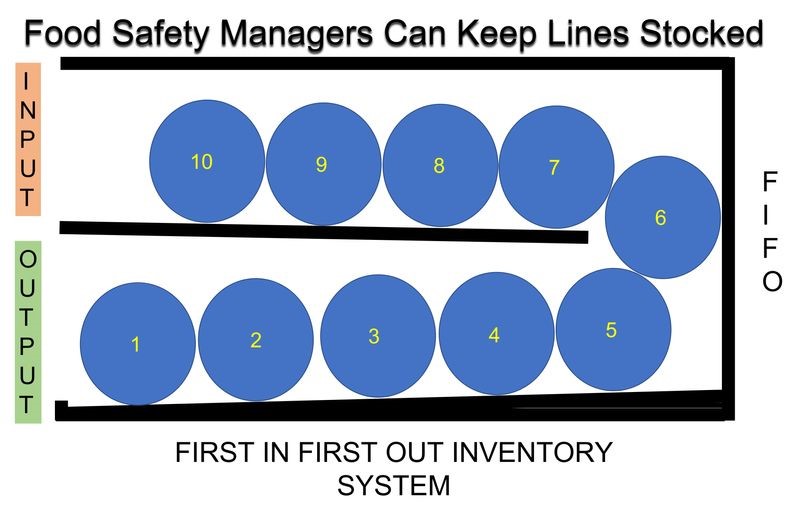
The most important thing to consider when stocking your production lines is that the oldest ingredients should be used first. Whatever method you use to stock your lines must take this into consideration. If you simply refill or top off storage containers, the oldest product will remain on the bottom and eventually begin to go bad contaminating all other product in the same container. When keeping your lines stocked, a first-in-first-out (FIFO) philosophy must be employed.

During food safety manager training classes, we’ve had a few discussions on stocking production lines, and it’s been asked if topping off containers and rotating product into clean containers is an acceptable method. While it sounds like a good idea to have a clean storage container every shift, you’re still running the risk of old product contaminating fresh ingredients. Imagine a pan filled with cheese that is one-third empty when you rotate it, and then you use one-third before the next time you rotate it, how fresh is the middle third? If you simply top off product and rotate it into a clean container, you may need an archeologist to date the product that has been trapped in the middle of your storage container every time you flip your lines.

Our suggestion is to have backup containers readily available rather than fill old containers with new product or rotate mixed-date products into new storage vessels. This will guarantee that fresh product doesn’t mix with older product that could be in danger of spoilage.

Do you have an effective strategy for keeping your ingredients stocked without mixing old and new product?