To pass the Minnesota Certified Food Protection Manager (CFPM) exam, you must score at least 70% to 75% (depending on the provider) on a proctored, 85-question multiple-choice test. The most effective way to ensure a first-time pass is to attend an in-person, 8-hour training session that covers the current FDA Food Code and Minnesota-specific health regulations.
Preparing for your food safety certification exam shouldn’t feel like a trip to the dentist. While the Minnesota Department of Health (MDH) requirements are strict, the exam is manageable if you know exactly what the state is looking for. At Safe Food Training, we achieve a pass rate of over 90% for our in-person students by focusing on the “heavy hitters”—the topics that consistently appear on the test.
Understanding the Minnesota Exam Landscape
In Minnesota, getting your “food license” is a two-step dance. First, you pass a nationally accredited exam, Such as those offered by Safe Food Training. Second, you apply to the Minnesota Department of Healthfor your state ID card using your passing certificate.
The exam itself isn’t just about common sense; it’s about technical standards. You’ll need to memorize specific numbers and concepts that are non-negotiable in a St. Paul or Minneapolis kitchen.
The Technical "Heavy Hitters"
Most people who struggle with the exam do so because they rely on “how we’ve always done it” in their specific kitchen rather than the textbook FDA Food Code.
The Big 6 Pathogens: You must recognize the names and transmission methods of the top foodborne illnesses: Shigella, Salmonella Typhi, Nontyphoidal Salmonella, Shiga toxin-producing E. coli (STEC), Hepatitis A, and Norovirus.
Employee Health Reporting: This is a big one. As a manager, you need to know when to “restrict” an employee (keep them away from food) and when to “exclude” them (send them home entirely) based on symptoms such as jaundice, a sore throat with fever, or vomiting.
The Storage Hierarchy
Cross-contamination is a major focus area. You’ll likely see a question about organizing a reach-in cooler. Always remember that the minimum internal cooking temperatures dictate the shelf order:
Top: Ready-to-eat foods (produce, cooked items).
Middle: Seafood and whole cuts of beef/pork (145°F).
Middle-Low: Ground meats and ground fish (155°F).
Bottom: Whole and ground poultry (165°F).
Choosing Your Training Path: In-Person vs. Online
We offer both formats, but there’s a clear winner when it comes to passing the first time without the stress of technical glitches or home distractions.
Feature
In-Person Training
Online Self-Paced
Pass Rate
Over 90%
Varies
Focus
Distraction-free (No “busy kitchen” interruptions)
Read the Full Question: The exam loves to use words like “Except,” “Never,” or “Always.” Don’t jump to the first “right” answer you see. Read all four options before marking your choice.
Think Like a Manager, Not a Chef: Sometimes, what we do during a Friday lunch rush isn’t the “textbook” answer the MDH wants. Always choose the answer that prioritizes public health and safety over speed or food cost.
Use the Process of Elimination: Usually, two of the four multiple-choice options are obviously wrong. Narrowing it down to two choices gives you a 50/50 shot, even on the toughest questions about specialized processes like HACCP.
Final Step: The State Application
Tips to pass your next CFPM exam!
Passing the test is a huge win, but you aren’t a “Certified Food Protection Manager” in the eyes of the state until you send in your formal application to the Minnesota Department of Health (MDH). At our in-person classes, we walk you through this paperwork so you don’t hit a snag at the finish line.
Ready to Get Your Minnesota Food Manager Certification?
Don’t leave your career to chance. Join Jeff Webster for a personalized, friendly, and highly experienced 8-hour training session. We provide all the materials, the instruction, and the proctored exam in one convenient day. We hold classes regularly in the Twin Cities, Rochester, Duluth, and beyond.
We get a lot of questions. Here are some that we get the most about passing exams:
Q: What is the primary service that Safe Food Training offers?
A: We specialize in providing personalized, 8-hour certified food protection manager licensing courses tailored for food professionals across Minnesota. We also offer dedicated continuing education training alongside our full certification course.
Q: Do you guarantee that I will pass the certification exam?
A: We’re committed to providing expert training that thoroughly prepares you for the exam. However, we don’t guarantee a passing result, as we believe in maintaining transparency and avoiding such claims.
Q: What happens if I don't pass the exam on my first attempt?
Food Safety Training in MN focuses on how to keep the food you serve safe, but from time to time we feel it is important to discuss how to keep you safe on the job. Burn incidents occur frequently in this business. Our food safety training team would like to share a few burn prevention tips.
Food Safety Team Tips on Workplace Burn Prevention
Here are our top three ways to reduce your risk of a severe burn:
Use mitts designed for hot handling
Ensure that production line personnel keep hot pans safely off the line
Exercise patience
Many chefs and food service professionals may disagree with our food safety team’s first suggestion, but we have seen quite a few burn incidents involving the use of a folded cloth towel and a hot pan. The cleaning towel’s design does not allow it to hold heat for an extended period of time, even when folded; it is not meant for that purpose. Cloth towels can also become damp or torn causing the heat to penetrate much faster.
Image credit: Wikimedia Commons
Hot pans coming out of the oven and placed on the production line are a common sight in busy restaurants. You must emphasize to your staff that food on these pans should be plated promptly. Accordingly, the hot pan should be removed without delay. Having hot pans lying near where a food worker can pick it up can greatly increase burn risk.
Our last food safety suggestion is one of the easiest burn prevention tips to teach but the hardest to practice. The food service industry is intense and induces a natural pressure for quick performance. No matter how much pressure you are under, do not open a steamer before it has finished or empty a fryer basket of food before excess oil has drained.
Recommends For Burn First Aid
If you do receive a burn on the job, it is important that you take care of it immediately to prevent further damage. The first thing you need to do is to immerse the burn under cool, running water for 10-20 minutes. Skin care products like aloe vera cream or an antibiotic ointment and pain medication can usually treat outer skin burns. Finally, wrap the burn in gauze and keep it clean. If the burn is more serious a urgent care or emergency room visit is advised. In any serious case, it may be advisable to take some time to allow it to heal before going back to work.
Preventing burns in the food preparation environment is certainly not the only issue that our food safety team can address. There are many hazards that are specific to the food service industry. Our food safety team would like to know which ones are of the most concern to you, and what hazards you would like to see covered in a future blog.
As most Minnesotans are aware, it frequently snows in our state. Businesses need to take steps to clean the snow on their properties in order to allow guests to visit. While businesses that don’t serve food have numerous options. Food businesses need to be extra careful when cleaning the snow around their buildings. Let’s take a quick look at how a certified food protection manager can prevent foodborne illness hazards that might arise from snow cleanup.
Image credit: rilueda via 123rf
The Connection Between Snow Removal and a Certified Food Protection Manager
Food protection managers should recognize that the potential for contamination in their facility may not come from the snow itself. It comes from the methods used to remove it. Salt, sand, chemical deicers and other non-shovel methods have the potential to make their way back into your facility after use on sidewalks and parking lots. Shoes, pants, long coats and even on staffs’ hands after building a snowman on their lunch break track in these snow removal contaminants. So how can we keep these chemicals out? The answer is, we can’t, at least not 100 percent of the time, but we can reduce the risks associated with them when it comes to food.
Non-Mechanical Snow Removal Solutions
Most snow removal techniques leave a residue that sticks to the bottom of shoes. Food protection managers should focus on items that are stored near ground level. Food product, utensils, plates or production implements should be stored in racks off the floor. Even boxes of to-go containers should at least be on a bottom shelf.
Deliveries can be a problem, since many food service suppliers simply drop off their shipments in a loading area in the back of the kitchen. If this is the case with your supplier, designate a place away from foot traffic and store all items as soon as possible.
If you have the opportunity to designate an employee entrance that does not open into the kitchen itself, you may wish to ask kitchen staff to use a different entrance to prevent tracking in sand or salt.
Do not wait until the end of the night to sweep and mop up high-trafficked areas. After the snow removal product has been tracked in to take care of it all at once. Direct staff to mop frequently to prevent buildup, create safer walkways and keep food safe.
How to you clear your parking lot and sidewalks for your guests in the winter?
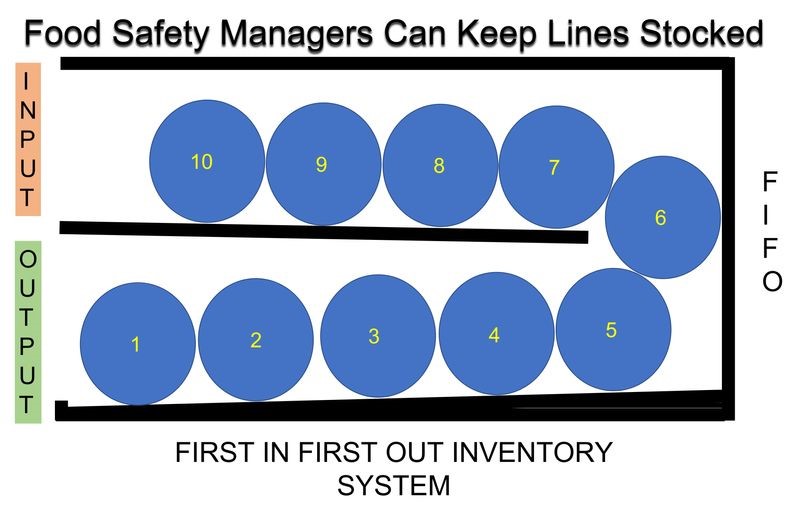
Food safety managers like to keep their production lines fully stocked so that all ingredients for every dish are readily available and in abundant supply, but there are foodborne illness hazards that can occur if you stock your lines improperly. Whether you call it rotating product, flipping your lines or simply stocking a quick access station, you should make sure that you’re doing it properly to reduce the risk of spreading illness.
How Food Safety Managers Reducing Foodborne Illness while Stocking Production Lines
The most important thing to consider when stocking your production lines is that the oldest ingredients should be used first. Whatever method you use to stock your lines must take this into consideration. If you simply refill or top off storage containers, the oldest product will remain on the bottom and eventually begin to go bad contaminating all other product in the same container. When keeping your lines stocked, a first-in-first-out (FIFO) philosophy must be employed.
During food safety manager training classes, we’ve had a few discussions on stocking production lines, and it’s been asked if topping off containers and rotating product into clean containers is an acceptable method. While it sounds like a good idea to have a clean storage container every shift, you’re still running the risk of old product contaminating fresh ingredients. Imagine a pan filled with cheese that is one-third empty when you rotate it, and then you use one-third before the next time you rotate it, how fresh is the middle third? If you simply top off product and rotate it into a clean container, you may need an archeologist to date the product that has been trapped in the middle of your storage container every time you flip your lines.
Our suggestion is to have backup containers readily available rather than fill old containers with new product or rotate mixed-date products into new storage vessels. This will guarantee that fresh product doesn’t mix with older product that could be in danger of spoilage.
Do you have an effective strategy for keeping your ingredients stocked without mixing old and new product?