MN Certified Food Manager Training and the Private Chef

MN Certified Food Manager Training and the Private Chef

When we offer MN certified food manager training, we teach students from every sector of the industry. In one of our recent sessions, we had a student whose goal was to become a private chef and offer catering services and culinary classes to individuals and small groups in their own homes. One question that was asked was if there were any special regulations that applied to private chefs that differ from the standard rules that apply to institutions, food producers and restaurants. We thought this was an interesting discussion, so we felt it beneficial to share some information that we have learned.

MN Certified Food Manager Training and the Private Chef
Image credit: Flickr

MN Certified Food Manager Training and the Personal Chef

While conducting our research, we found that there are a few different regulations that vary by county or metro area, but there are four licenses or certifications that most jurisdictions will require:

  • Minnesota Food Manager Certification
  • A License to Run a Food Establishment
  • A Catering License
  • A Federal Tax ID (EIN)

If you’re considering becoming a personal chef, we suggest that you contact your local government office to find out which licenses you need in your particular jurisdiction. If you need your MN certified food manager training, we would be happy to tailor a course designed specifically for your catering venture.

There are a few other aspects of being a personal chef that differ from regular catering services. While in many cases it is acceptable to prepare food for clients at their home or other location, you should be aware that most jurisdictions will require you to have a preparation and storage facility that can be inspected by the health department. This presents a unique challenge for many personal chefs whose clientele consists of a small number of people.

We have been asked if private chefs are allowed to use their own personal home kitchens to prepare food before transporting it to a client’s location. Unfortunately, this is not an acceptable solution according the health inspector we discussed this scenario with. Many private chefs solve this problem by leasing space from other caterers with industrial kitchens or local restaurants who are willing to allow them access to their kitchen before they begin their service for the day.

Personal chefs are not the only unique part of the food industry. If you’re considering any food based business that doesn’t quite conform to industry standards, please leave your ideas in the comments section and we’ll do our best to cover it in a future article.

How MN Certified Food Managers Take Advantage of Black Friday

MN Certified Food Managers and Black Friday

Black Friday arrives at the end of the month, with the shopping frenzy approaching, we decided that it would be beneficial to discuss how MN Certified Food Managers at local restaurants and food producers can take advantage of the millions of potential guests that are out and about the day after Thanksgiving.

MN Food Safety Managers and Black Friday
Image credit: Powhusku via Wikimedia Commons


MN Food Safety Managers and Black Friday

We think that this day is a prime opportunity for MN Certified Food Managers to show what they can do and build their customer base. Here are a few ideas that we think can attract customers who have finished their shopping or are looking for a quick meal on the go.

  • Run easy to serve take-out specials
  • Offer free items with any order
  • Offer promotions based on the time of day

Many of the shoppers on Black Friday will be in a hurry and won’t want to take the time to sit down to eat breakfast or lunch. If your restaurant has hot food ready to go that your guests can order and receive without a long wait, it may attract customers who are looking for grab-and-go dining options.

Everyone loves free stuff, even if they have to buy something else to get it. We suggest offering something that is easy and affordable. Many shoppers will have already been out since midnight, and something as inexpensive as a free cup of coffee or espresso with every order will look attractive to guests looking for that extra boost to finish off their search for the best deal.

Last year, we noticed that one restaurant changed their promotions every hour. We think this is a great idea to let your guests see what is coming up, and, if they don’t have time to stop right away, it may give them an incentive to return later in the day.

Finally, don’t forget to advertise your restaurant in the days leading up to Black Friday. Social media is a great way to get the word out there. With outlets like Twitter and Facebook, MN food safety managers can plug their restaurants for free with a few creative hashtags.

Over the past few years, we’ve seen different strategies when it comes to making the most out of Black Friday. What will your business be doing to attract customers?

Minnesota Certified Food Managers Alert: For Restaurant Fire Hazards

Minnesota Certified Food Managers Alert Regarding Restaurant Fire Hazards

As Minnesota certified food managers we are trained to create a safe eating experience for our guests. But owners and food service managers must bear in mind more than just food safety to protect employees and customers. This is the fourth in a series of blogs that look specifically at the hazards that Scott Futrell, a local fire protection consultant, has provided to assist you in protecting your customers, business and employees.

What can Owners and Minnesota Certified Food Managers do to protect your investment or your facility?

The Minnesota State Fire Code requires you to maintain your fire protection equipment in working condition.  There are procedures you should establish for you and your staff in addition to hiring competent contractors to clean and inspect and test your systems and equipment.

Basically the Codes and Standards require you to inspect, test, and maintain your kitchen hood, duct, fan, and suppression systems in accordance with the manufacturer’s requirements.  Thus it is essential you obtain from the contractor the minimum requirements for inspection, testing, and maintenance and then understand your responsibilities and the very limited, or minimal, portions of these requirements that the contractor will actually perform.

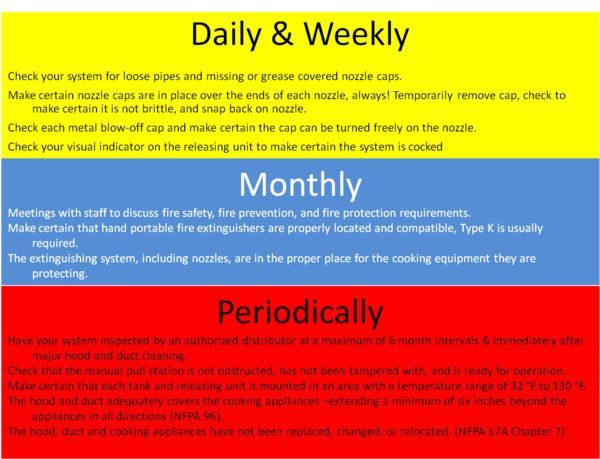
Checklist for Kitchen Fire Safety

The owner’s responsibility for inspection and maintenance of wet chemical systems on a daily, weekly, and monthly basis should include the following at a minimum:

Minnesota Certified Food Managers Alert Regarding Restaurant Fire Hazards

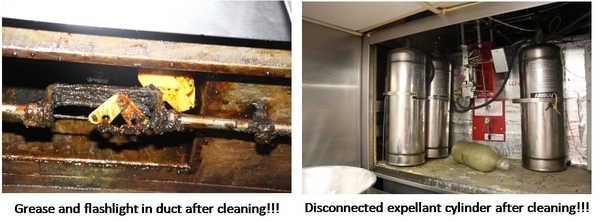
It is very important to note that often the fusible links are wired shut during the cleaning process to prevent accidental activation preventing the system from operating automatically. It’s also possible that your system might have been disconnected, damaged, or has accumulated excessive deposits of grease causing your system to become inoperative, see Figure 1.


Minnesota Certified Food Managers Alert: For Restaurant Fire Hazards
Figure 1 – Post Grease
All Image credits: Futrell Fire Consult & Design, Inc

Both of these pictures were taken post-fire, where the suppression system did not operate because the expellant was disconnected.  Note that the grease cleaning was not performed thoroughly. The fire occurred the day after the cleaning!

The bottom line is this:

  • Contractors that you hire for inspection, testing and maintenance do not perform all of the safety checks that need to be done on your systems on a daily, weekly, or periodic basis;
  • your responsibilities include staff education as well as performing daily, weekly, and periodic inspections;
  • your responsibilities include observing the hoods, ducts, and fire protection devices after the contractor’s complete their work; and
  • schedule the fire suppression six-month inspection, test, and maintenance immediately after the hood, duct, and fan cleaning.

If you want more information or have any questions about fire safety in the food preparation environment that you would like Scott to discuss leave a comment.

ABOUT THE AUTHOR: Scott A. Futrell, PE, FSFPE, CFPS, SET, CFEI, is a fire protection consultant with Futrell Fire Consult & Design, Inc., in Osseo, Minnesota and has over 40 years’ experience designing, specifying, and investigating fire protection system related losses and can be reached by e-mail at: scottf@ffcdi.com, or visit www.ffcdi.com.

Alfalfa Sprouts and the MN Certified Food Manager

Alfalfa Sprouts and the MN Certified Food Manager
Photo credit: commons.wikimedia.org

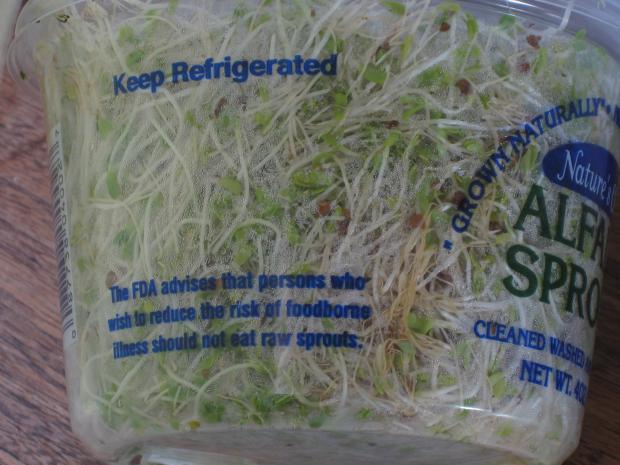
In the month of February, an E. coli outbreak linked to fresh sprouts struck the states of Minnesota and Wisconsin. Fresh alfalfa sprouts have been linked to several food-borne illness cases over the past several years, so we’d like to take the time to review how MN certified food managers can keep their customers from consuming tainted sprouts and other sensitive raw produce items.

Sensitive Produce Items and the MN Certified Food Manager

The recent E. coli outbreak in our state wasn’t merely an isolated incident. In a completely unrelated outbreak this year, sprouts grown in Kansas have been found to be the cause of illnesses as far away as Pennsylvania. When something like this happens, we like to take the time to have a discussion on how food service professionals can prevent these types of incidents from affecting their guests.

It is never safe to assume that raw sprouts, or any other raw produce items, are safe to consume right out of its packaging. All produce should be thoroughly rinsed and dried before it is made available to your customers.

Secondly, you should always throw away or return recalled produce items to your supplier. In this most recent case, the health department has warned that there may still be recalled alfalfa sprouts on retail store shelves or in food preparation facilities. On our blog page, we’ve incorporated a widget that will help you stay current on any recall information, and we suggest you check it regularly to make sure that you do not have recalled items in your inventory.

Finally, you should never serve raw sprouts of any kind if your regular customer base includes individuals that are susceptible to food-borne illness. The FDA recommends that alfalfa sprouts never be served to the elderly, children or those who have depleted immune systems. If you are in charge of food service for a school, assisted living home or medical facility, we strongly urge you to keep raw sprouts off of the menu.

At Safe Food Training, we like to hear how our readers deal with these types of situations. Do you serve raw alfalfa sprouts in your facility, or would you rather not take the risk and keep them off of your menu entirely?