Keep your MN kitchen running smoothly. We’re sharing real-world ServSafe & NEHA Best Practices to help you train staff and ace your next health inspection.

A lesson in Improper Food Safety Training from South Africa

A Lesson in Improper Food Safety Training from South Africa

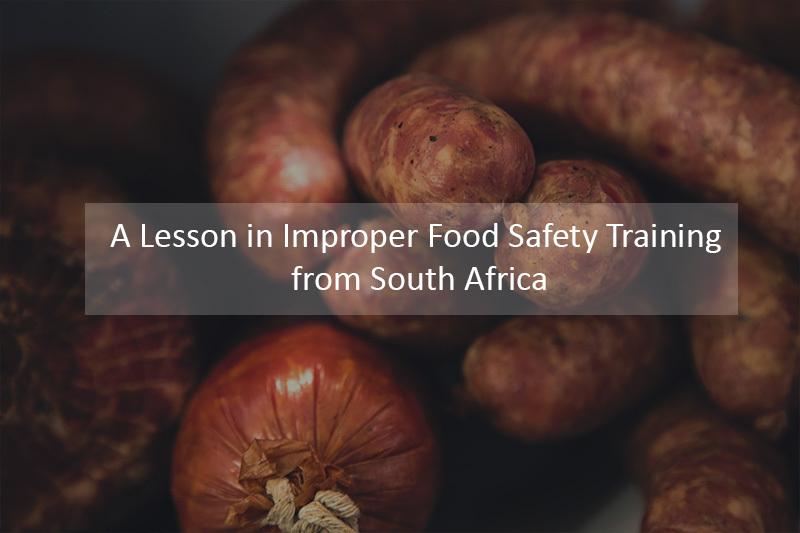
While we usually focus on food safety training in Minnesota and food-handling issues in the United States, the listeria outbreak in South Africa is too big of a news story to ignore. With a death toll around 200, this outbreak breaks records as the largest listeria case in the world.

A Food Safety Training Case Study and a South African Outbreak

A lesson in Improper Food Safety Training from South Africa

Image Credit: mayushka

Investigators have traced the source of this outbreak to a South African processed meat product called polony. The listeria bacterium found on the exterior casing of this meat product poses an incredibly high probability that other products have also become contaminated. The risk of cross-contamination from this outbreak prompted health officials to recommend that the residents of South Africa avoid consuming any ready-to-eat processed meat products. Between January and March, nearly 700 cases of infection from this strain have been confirmed, and this outbreak has a staggering 27-percent fatality rate.

It’s vital that we don’t simply write this outbreak off as happening in another country because it doesn’t affect food producers in Minnesota and the United States. This product may never be sold in our stores, but it should serve as a dire warning as to the consequences of a lack of food safety training, especially with something as preventable as listeria poisoning. Now could be a good time to review hand washing and equipment sanitation procedures with your staff since many cases of listeria begin with improper sanitation procedures.

Have you been following this major food safety story and has it impacted how you look at basic food handling training?

Food Safety Certified Procedures for Produce

Food Safety Certified Procedures for Produce

In ServSafe training, food safety certified professionals learn that washing raw fruits and vegetables before serving helps prevent the spread of food borne-illness. We all know that plants grow in the dirt, and dirt contains bacteria that can be harmful if consumed. Some farms utilize fertilizers and pesticides to yield a larger crop, and residues of these compounds may still exist on the surface of fruits and vegetables. We’d like to suggest that restaurants develop standards that require all produce to be washed before any use.

Food Safety Certified Procedures for Produce
Copyright: denisfilm / 123RF Stock Photo

Washing of Produce and Food Safety Certified Standards

Even if you plan to cook your fruits or vegetables, there may be a chance that pathogens on their surface can spread. During preparation, they will inevitably come into contact with knives, prep surfaces and hands that will then go on to touch other items in your kitchen.

Produce ingredients that often go unwashed include fruits and vegetables with peels or rinds. Some examples of these include:

  • Carrots, beets and other root vegetables
  • Avocados
  • Melons
  • Oranges, pineapples and other tree fruits
  • Thick-skinned squash such as pumpkins and butternut squash

During classes prepared for food safety certified managers, we’ve often been asked why we feel it’s necessary to wash these items before preparation; the customer will never eat the peels. Your knives and peelers can come into contact with contaminates on the surface of these ingredients and then become infected. The grooved surface of a cantaloupe, for example, contains many nooks and crevices for bacteria and remnants of fertilizer to reside. As you slice through the surface, your knife can pick up these microscopic particles and spread them to the meat of the fruit as your knife passes through. The same theory can be applied to a peeler that picks up contaminates while root vegetables are being prepared.

Washing all produce is just one small way to prevent food-borne illness, and should never be overlooked. Can you think of any small, but necessary, procedures you feel gets forgotten far too often.

When Should Certified Food Managers Return From the Flu

When Certified Food Managers Should Return From the Flu?

With flu season in full swing, it’s important that certified food managers recognize the symptoms in themselves and their staff, as well as make tough decisions as to whether they should be at work with or without symptoms. Influenza can easily be spread to guests and co-workers even after symptoms have passed.

When Should Certified Food Managers Return From the Flu

Image credit: PXhere under Creative Commons CC0

Taking Precautions Against Influenza

While monitoring the CDC’s flu data, we note that this illness is something that affects the entire country and currently poses an elevated risk. This means that the possibility exists that your establishment will have staff that misses time due to the flu.

The flu has the potential to be more than an annoyance, it has the potential to be deadly, especially in the food service industry where it can be spread to those that are susceptible. If you or a member of your staff even suspects they are infected, we strongly urge that you do not work.

One dilemma that arises is the timetable for returning to work after the flu. In some cases, a worker infected with the flu may still be contagious once symptoms begin to dissipate. Taking a day or two off after symptoms disappear may be advisable. Just because symptoms have lessened or that you feel as if you could make it through your shift does not mean you are ready to return to work. To put it simply, we feel that certified food managers and food service workers should take extra time before returning to work, even if they feel well enough to perform their duties.

The certified food manager should take steps to stay healthy during this season and recover fully if they become ill. We’d recommend visiting your physician if you are concerned about your health and not returning to work until they confirm you are no longer contagious.

If you are not ill, remember to wash your hands frequently, even when not at work. While it’s common food safety procedure to wash your hands frequently, it will also prevent illnesses like the flu from spreading outside of the kitchen environment. Keeping hydrated is also key. Kitchens are hot and restaurant workers often risk dehydration. Drinking plenty of water will help keep illness at bay.

Does your facility have any precautions to prevent illnesses like the flu from spreading to your guests?

ServSafe Manager Certification and Protection from Food Tampering

ServSafe Manager Certification and Protection from Food Tampering

Most of the food-borne illness threats that we look at usually come from inadvertent contamination due to either a lack of training, negligence or an infected food source, but the threat of intentional contamination exists and steps should be taken to prevent this kind of scenario.

Food Terrorism and ServSafe Manager Certification

55830618 – cardboard egg tray with chicken eggs. social concept: stop terrorism. angle view.

Food Terrorism and ServSafe Manager Certification

Few ServSafe manager certification courses cover the prevention of intentional food tampering, but according to the Food Safety Modernization Act (FSMA), certain food production facilities must take steps to prevent hazards from being intentionally introduced into the food production process that could cause wide-spread effects.

In a recent interview, advisors from the FDA’s Food Defense and Emergency Coordination staff provided some insight into the rule and how to keep food safe.

One key component of this rule is the identification and protection of areas of vulnerability. The article discusses open storage containers and mixing vats as potential targets for someone trying to tamper with your food. Other vulnerable sites in food production facilities could include outdoor gardens, unattended receiving areas or unsupervised areas of the kitchen after hours.

ServSafe Manager Certification and Protection from Food Tampering

Image credit: ANDRII POPRAVKA,123

Food defense has long been voluntary, and many facilities do have safety standards in place to prevent malicious tampering with their product. The food defense requirement of the FSMA for large businesses takes effect July 26, 2019 and July 26, 2020 for small businesses with under 500 employees. Very small businesses may be exempt from these rules, but they must provide documentation that they are exempt by July of 2021.

Thankfully, the chances of an intentional food-poisoning outbreak are miniscule whether on a mass scale or at a smaller level. Do you do anything to prevent tampering with the product you prepare and serve at your facility?