Keep your MN kitchen running smoothly. We’re sharing real-world ServSafe & NEHA Best Practices to help you train staff and ace your next health inspection.

A Practical Way Food Safety Managers Can Keep Lines Stocked

A Practical Way Food Safety Managers Can Keep Lines Stocked

Food safety managers like to keep their production lines fully stocked so that all ingredients for every dish are readily available and in abundant supply, but there are foodborne illness hazards that can occur if you stock your lines improperly. Whether you call it rotating product, flipping your lines or simply stocking a quick access station, you should make sure that you’re doing it properly to reduce the risk of spreading illness.

A Practical Way Food Safety Managers Can Keep Lines Stocked

How Food Safety Managers Reducing Foodborne Illness while Stocking Production Lines

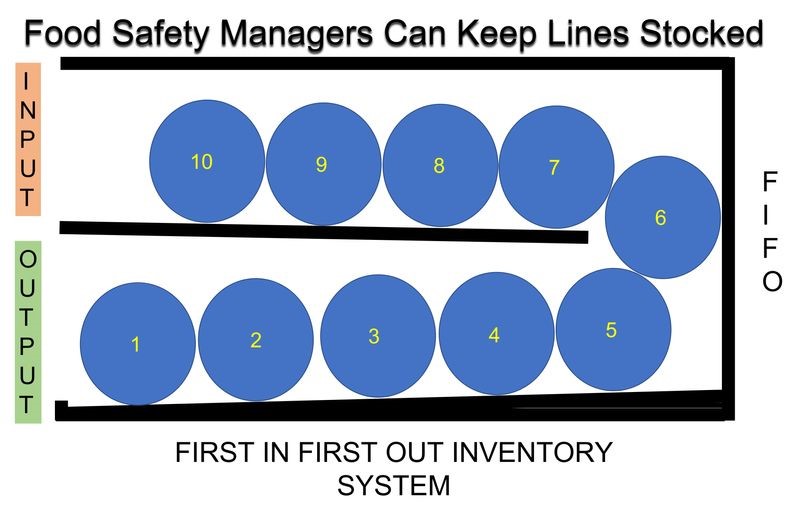
The most important thing to consider when stocking your production lines is that the oldest ingredients should be used first. Whatever method you use to stock your lines must take this into consideration. If you simply refill or top off storage containers, the oldest product will remain on the bottom and eventually begin to go bad contaminating all other product in the same container. When keeping your lines stocked, a first-in-first-out (FIFO) philosophy must be employed.

During food safety manager training classes, we’ve had a few discussions on stocking production lines, and it’s been asked if topping off containers and rotating product into clean containers is an acceptable method. While it sounds like a good idea to have a clean storage container every shift, you’re still running the risk of old product contaminating fresh ingredients. Imagine a pan filled with cheese that is one-third empty when you rotate it, and then you use one-third before the next time you rotate it, how fresh is the middle third? If you simply top off product and rotate it into a clean container, you may need an archeologist to date the product that has been trapped in the middle of your storage container every time you flip your lines.

Our suggestion is to have backup containers readily available rather than fill old containers with new product or rotate mixed-date products into new storage vessels. This will guarantee that fresh product doesn’t mix with older product that could be in danger of spoilage.

Do you have an effective strategy for keeping your ingredients stocked without mixing old and new product?

Guide For Retail ServSafe Food Managers To Safely Sample Product

A How To Guide For Retail ServSafe Food Managers To Safely Sample Product

Many retail food businesses offer samples as a way to boost their sales, but before retail ServSafe food managers begin loading up trays of their product, they should be careful to ensure that they’re providing their potential customers with samples that are low-risk for foodborne illness. Observing common sense food-handling procedures will go a long way towards keeping samples safe, but there are some special steps that should be taken when sampling your product to the public.

How To Guide For Retail ServSafe Food Managers To Safely Sample Product
Image credit: leaf via 123rf

How Retail ServSafe Food Managers can Safely Sample Product

A quick look at Minnesota food code guidelines regarding retail sampling shows us five things retail ServSafe food managers should monitor when offering samples:

  • Handwashing
  • Bare-hand Contact
  • Holding Temperature
  • Warewashing and Sanitation Procedures
  • Employee Hygiene

Clean hands and proper food handling with food-grade gloves or utensils is one of the most proven ways to prevent food contamination from dirty hands, so any employee monitoring a sample station should have nearby access to a handwashing station. Be aware that bathroom sinks are not approved handwashing stations, so ensure access to a properly stocked handwashing station. Also, be aware that any sample touched by a customer and put back should be discarded since it has been handled by unclean hands.

If food is served hot or cold retail ServSafe food managers must make sure it remains out of the danger zone when stored at sampling stations. When sampling foods that cannot be stored at room temperature, make sure that you limit the amount of product on sampling surfaces to keep them as fresh as possible. This will reduce foodborne illness risk and also make your product more appealing.

All utensils used in service must be properly washed using an approved warewashing machine or triple sink method. Sampling stations should have a properly mixed sanitizer solution available in order to keep surfaces clean and germ-free.

Finally, retail ServSafe food managers should not allow ill employees to monitor sampling stations or work in other areas of the business. If you have a sick employee, send them home and make sure they are symptom-free before they return to work.

Are you a retail ServSafe food manager who offers samples to boost product sales?

Recall creates unexpected problems for ServSafe food managers

Latest Recall Creates Unexpected Problems For ServSafe Food Managers

In a major nationwide notice, the J.M. Smucker Corporation has recalled large batches of Jif peanut butter due to concerns over possible salmonella contamination. Due to the long shelf life of peanut butter and the numerous types of packaging being recalled, ServSafe food managers should take action now to prevent foodborne illness risks in the long run.

How ServSafe Food Manager Should Approach Recall Problems

Latest Recall Creates Unexpected Problems For ServSafe Food Managers

Many restaurants and other food outlets that use peanut butter sparingly enough that may simply purchase it in small quantities from grocery stores rather than large buckets from food service suppliers. ServSafe food managers that stock Jif peanut butter should take a close look at the recalled product ID numbers to ensure they do not have any potentially contaminated product on hand. If you do find recalled jars of peanut butter in storage, dispose of both opened and unopened containers.

Beyond jars of different sizes, this recall also affects smaller packages and grab-and-go style cups of Jif peanut butter. Cafeterias, hospitality businesses and other places that offer pre-packaged single-serving peanut butter cups need to investigate to see if these products have been recalled. These single-serving cups are not only available by themselves, but are also packaged in lunch kits and other grab-and-go snack packages.

Finally, you may want to consider disposing of product made with Jif peanut butter that was purchased during the dates contaminated peanut butter was shipped. It may sound like a drastic move, but if it saves your guests from salmonella poisoning risks, it may just be worth it.

Have you checked the FDA recall list lately?

Food safety advice for visitors in the kitchen

Food Safety Advice For Visitors In The Kitchen

The kitchen of most food businesses can be a busy place, and often you may have vendors, maintenance staff and other non-food service personnel either working or passing through your kitchen. Since these guests are not technically food-service workers, is there any outlined food safety management training necessary for these individuals? Food safety managers are obligated to cover every foodborne illness risk, and this may mean taking the time to assess what steps need to be taken for non-staff kitchen visitors in your establishment.

Food Safety Advice For Visitors In The Kitchen
Image credit: highwaystarz via 123rf

Food Safety Precautions for Visitors in Food Preparation Areas

Before we take the time to discuss precautions, it may be important to outline who should and should not be visiting your kitchen. There are many individuals who have business there, but before we invite grandma and the neighbors to hang out on the line there should be some ground rules.

When considering outside visitors, kitchen managers need to ask staff to respect the boundaries of the kitchen. If visitors don’t have a business-related purpose in food preparation areas, they should be asked to wait in public spaces. It’s not that we’re against friends and family stopping by; it just adds potential safety risks and possible foodborne-illness hazards to have untrained personnel in the kitchen.

Outside individuals who may have business in your establishment may include:

  • Vendor representatives
  • Delivery personnel
  • Maintenance staff
  • Corporate managers

Your vendors and food service suppliers should already have some situational awareness in the kitchen and may know better than to get in the way in a busy environment. However, if they’re handling food that is being inspected, sampled or delivered, it’s best to ensure bare-hand contact rules are followed. The same goes for delivery drivers. Most of these types of kitchen visitors have already been trained in some respects for food safety, but it’s always prudent to keep an eye out for potential contamination risks.

If you have planned maintenance whether it’s hood vent cleaning, equipment repair or any other type of work being done in your kitchen that does not involve food preparation, take steps to ensure that all food product is removed from areas where work is being done. Even if it’s something as simple as having new shelving installed in dry storage, the potential for contamination can be high in these situations.

Finally, larger food businesses, especially those with multiple locations, may have corporate higher-ups stop by. Most of these types may not have had food safety management training but may look to get involved in some food preparation activities during their time in your kitchen. Be prepared to respectfully ask them to not handle food if that is not the nature of their visit.

How do you deal with visitors to your establishment?