
C:\Users\Dave\Pictures\Pictures\Street Level Solutions\SFT\Blog photos\Dollar-Photo-Club\Food_Training_Certification_and_Reducing_Sugar.png

Food Training Certification and Reducing Sugar

Food training certification often overlooks the benefits of proper nutrition, but nutrition impacts many aspects of the food service industry. A recent report from the American Heart Association recommends children between the ages of two and 18 only consume 25 grams of sugar per day. We visit many different local restaurants, and we see that many kid’s menus contain options that potentially exceed the AMA’s guidelines.

Food Training Certification and Sugar Consumption in Children

Eating too much sugar will not create a food-borne illness risk for children, but certain health conditions such as hyperactivity, heart disease and obesity have been linked to sweetened foods and drinks. Should this concern kitchen managers and restaurant supervisors? Some feel that parents make choices for their children, so some feel that restaurants are not responsible for how much sugar their meals contain. That can be true to a certain extent, but with parents searching for health conscious choices for their children’s lunches and dinners it is advantageous to at least provide some low-sugar alternatives.

Finding a substitute for high-sugar ingredients can be a challenge, but replacing a few canned or prepackaged items with fresh ingredients will go a long way. Preservatives in canned items increase sugar content, especially in canned fruit that is a common side served to children. Providing fresh fruit or vegetables as a side offers a healthy and low sugar option.

Sauces also contain added sugars. Just by reading the label of readily available canned pasta sauce, you can learn that many of these sauces contain nearly half of the AMA’s recommended amount of sugar in as little as one serving. If you are considering reducing the amount of sugar you serve to children, we suggest you take the time to assess all of your prepackaged ingredient items and consider whether or not it would be beneficial to make these ingredients from scratch or find a fresh food alternative.

Finally, soda and other sweetened beverages contain plenty of sugar. We understand children love their soda and you cannot remove soda completely from your menus, but offering milk and fresh juices as an alternative will please parents looking for low sugar choices.

We love to explore health issues beyond food-borne illnesses and food training certification. If there is something that you would like to us explore that isn’t covered in an online food safety course, feel free to suggest a topic in the comment section below.
Minnesota Certified Food Managers Alert Regarding Restaurant Fire Hazards

Minnesota Certified Food Managers Alert: For Restaurant Fire Hazards

As Minnesota certified food managers we are trained to create a safe eating experience for our guests. But owners and food service managers must bear in mind more than just food safety to protect employees and customers. This is the fourth in a series of blogs that look specifically at the hazards that Scott Futrell, a local fire protection consultant, has provided to assist you in protecting your customers, business and employees.

What can Owners and Minnesota Certified Food Managers do to protect your investment or your facility?

The Minnesota State Fire Code requires you to maintain your fire protection equipment in working condition.  There are procedures you should establish for you and your staff in addition to hiring competent contractors to clean and inspect and test your systems and equipment.

Basically the Codes and Standards require you to inspect, test, and maintain your kitchen hood, duct, fan, and suppression systems in accordance with the manufacturer’s requirements.  Thus it is essential you obtain from the contractor the minimum requirements for inspection, testing, and maintenance and then understand your responsibilities and the very limited, or minimal, portions of these requirements that the contractor will actually perform.

Checklist for Kitchen Fire Safety

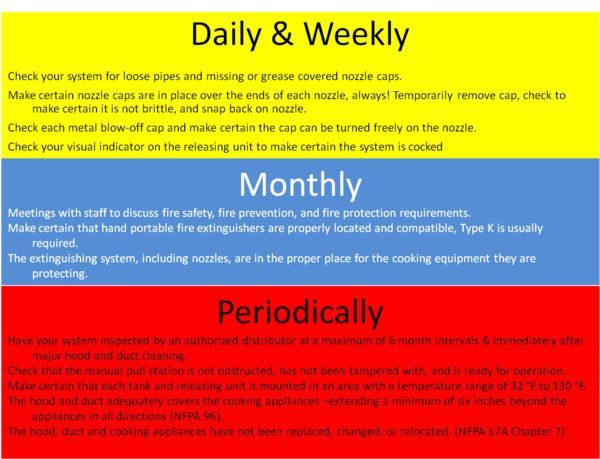
The owner’s responsibility for inspection and maintenance of wet chemical systems on a daily, weekly, and monthly basis should include the following at a minimum:

Minnesota Certified Food Managers Alert Regarding Restaurant Fire Hazards

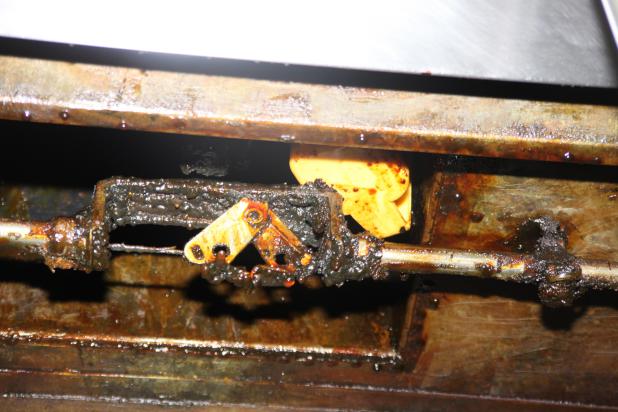
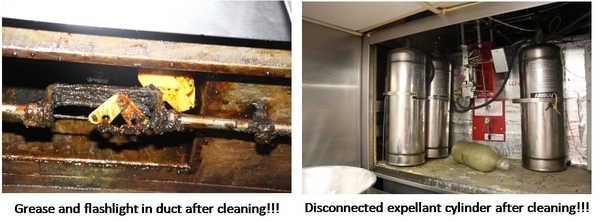
It is very important to note that often the fusible links are wired shut during the cleaning process to prevent accidental activation preventing the system from operating automatically. It’s also possible that your system might have been disconnected, damaged, or has accumulated excessive deposits of grease causing your system to become inoperative, see Figure 1.


Minnesota Certified Food Managers Alert: For Restaurant Fire Hazards

Figure 1 – Post Grease
All Image credits: Futrell Fire Consult & Design, Inc

Both of these pictures were taken post-fire, where the suppression system did not operate because the expellant was disconnected.  Note that the grease cleaning was not performed thoroughly. The fire occurred the day after the cleaning!

The bottom line is this:

  • Contractors that you hire for inspection, testing and maintenance do not perform all of the safety checks that need to be done on your systems on a daily, weekly, or periodic basis;
  • your responsibilities include staff education as well as performing daily, weekly, and periodic inspections;
  • your responsibilities include observing the hoods, ducts, and fire protection devices after the contractor’s complete their work; and
  • schedule the fire suppression six-month inspection, test, and maintenance immediately after the hood, duct, and fan cleaning.

If you want more information or have any questions about fire safety in the food preparation environment that you would like Scott to discuss leave a comment.

ABOUT THE AUTHOR: Scott A. Futrell, PE, FSFPE, CFPS, SET, CFEI, is a fire protection consultant with Futrell Fire Consult & Design, Inc., in Osseo, Minnesota and has over 40 years’ experience designing, specifying, and investigating fire protection system related losses and can be reached by e-mail at: scottf@ffcdi.com, or visit www.ffcdi.com.

Minnesota Certified Food Managers Alert watch for Kitchen Hood with Black Steel Pipe

Minnesota Food Safety Managers Alert: For Restaurant Fire Hazards

Minnesota Certified Food Managers Alert watch for Kitchen Hood with Black Steel Pipe

Kitchen Hood with Black Steel Pipe
Figure 1
All image credits: Scott Futrell

As Minnesota food safety managers we are trained to create a safe eating experience for our guests. Delivering food safe for human consumption includes many variables.  Sometimes overlooked are the grease and creosote cleaning and fire protection requirements in the commercial hoods above the cook line. As owners and managers we can do a variety of things to improve the safety for our staff and guests as well as protecting our business. That’s why Safe Food Training has asked, Scott Futrell, a local fire protection consultant to discuss some of the fire safety issues owners and managers should consider. This is the second in a series of blogs that will explore fire safety in the food preparation environment.


Fire safety in your kitchen and your restaurant

In our last issue we looked into the statistics both nationwide and in Minnesota relating to fires in eating and drinking establishments.  We can reduce the odds of a fire impacting our business if we frequently and routinely do several things.


It is very important that grease and creosote, if you use solid-fuel burning appliances is kept off of and out of the hood, filters, plenums, ducts, fans and fire protection nozzles.  Yes the nozzles. But more on that later on.  The hoods, filters, plenums, ducts, and fans are required to be cleaned to bare metal semi-annually for most of you.  Sometimes more frequently and sometimes annually. Many of you do the filters (weekly) and the exposed surfaces (daily), but how can you do that effectively when the piping isn’t stainless steel? See Figure 1. Minnesota Statute: 4626.0495 4-101.111 Non-food-contact surfaces.


What can Minnesota Food Safety Managers do to protect your investment or your facility?

Minnesota Food Safety Managers Watch for Grease in Plenum

Grease in Plenum
Figure 2

Do you ever look behind the filters and into the exhaust ductwork? A spark, a flare up, or a grill cleaning fire that is too hot can ignite the grease that builds up causing a fire and a loss. See Figure 2 for the grease that remained the day after the professional cleaning and yes, the cleaner left their flashlight in there.

On the other hand, that same grease gets into the fire suppression nozzles if the caps are off and then when the system needs to operate it can’t flow agent out of the grease plugged nozzles.  See Figure 3 for a nozzle with the cap off and for a nozzle with grease caked inside of it post-fire.

Minnesota Certified Food Managers Fire Suppression Monitor Nozzels

Nozzle Missing Cap and Grease in Nozzle
Figure 3


If you have any questions about fire safety in the food preparation environment that you would like Scott to discuss leave a comment below.

ABOUT THE AUTHOR: Scott A. Futrell, PE, FSFPE, CFPS, SET, CFEI, is a fire protection consultant with Futrell Fire Consult & Design, Inc., in Osseo, Minnesota and has over 40 years’ experience designing, specifying, and investigating fire protection system related losses and can be reached by e-mail at: scottf@ffcdi.com, or visit www.ffcdi.com.

Seasonal Staff and Food Safety Certification MN Requirement Training

Seasonal Staff and Food Safety Certification MN Requirements


Many restaurants and food-production facilities will take on seasonal help to assist with higher volume during the busy summer season and to account for full-time employees’ vacation requests. With so many incoming part-time staff, there are difficulties when it comes time to take care of training, orientation and food safety certification MN requirements. At Safe Food Training, we have a few tips to help transition your seasonal staff into your regular staff efficiently so that you will lose as little time as possible bringing them up to speed.

Integrating Seasonal Staff into Your Operation

From what we have heard during our interactions with local food industry professionals, we have encountered three common problems that are inherent in hiring seasonal workers.


  • Making sure each new hire understands company policies
  • Training new employees efficiently
  • Getting each new employee the proper food safety certification MN requirements

Many companies forgo a formal orientation session for their seasonal workers. They feel that paying them to attend an orientation seminar is unnecessary since they may only be around for a small amount of time. We disagree. We think that it is important to have everyone on the same page as far as knowing what your facility’s operating procedures are. Taking care of this in one session where all of your seasonal help is in attendance will save valuable time rather than explaining each rule as workplace situations arise.


The opposite may be true when it comes to training your new hires. Many people are hands-on learners or hands-on teachers. The nature of the food industry requires some hands-on learning in order to understand how to get things done right. Breaking down your seasonal hires into smaller groups, or even setting up one-on-one training sessions will get them up to speed much faster than large on-the-job training groups.


Finally, you will have to make sure that all of your seasonal hires have the proper food handler permits and food safety certification MN requirements. When it comes to ensuring that all of your new employees have the necessary certifications, Safe Food Training is more than happy to help. We can set up group training sessions at your restaurant, hotel or any other type of food preparation facility. We can take into account the specific nature of your business and develop a food safety certification MN course that directly addresses the unique needs of your company’s operations.


Are you a food-production business that finds it necessary to take on several seasonal staff members during the summer months? If you have any tips for your fellow food-industry professionals to help smooth the process of integrating your temporary employees, please leave them in the comments below.