Food Safety Training and Salmonella Linked to MN Juice Bar

Last month, the Minnesota Department of Health announced they were investigating a salmonella outbreak linked to Nektar juice bar in Woodbury. At least nine people were sickened, but due to the nature of salmonella there’s a good chance that more patrons were afflicted. Symptoms of the bacteria can sometimes be either too mild to recognize as food poisoning or require medical attention. It should also be noted, that the nine customers stricken with salmonella symptoms reported ordering a variety of items including bowls, smoothies and juices. With such a variety of menu items attributed to this outbreak, the Department of Health has yet to determine the exact ingredient that spread the illness, What food safety training practices could have helped to prevent the recent salmonella outbreak?

What food safety training practices could help prevent salmonella outbreaks?
Image credit: orentodoros via pixabay

Food Safety Training and Equipment Sanitation

While we’re not familiar with the specifics of the case, we do have a possible scenario that may have led to this outbreak which sickened at least nine and hospitalized two. A gap in food safety training when it comes to sanitizing equipment may have been a factor in this outbreak.

In juice bars, the same blender or preparation surface are often used for many different purposes, so there may have been a lack in sanitation in between serving customers. If an ingredient was unknowingly compromised with salmonella bacteria and this bacteria contaminated any piece of equipment or preparation surface then it could have easily spread to other items containing different ingredients. It’s not necessarily required to sanitize every surface that comes into contact with vegetable matter if that surface is going to be used immediately for another type of fruit or vegetable, but it may be a wise precaution. The same goes for equipment such as wand blenders and mixers. If a contaminated leafy green was prepared on a cutting board which was then immediately used to chop carrots, no food safety training principle was violated, but yet salmonella could have spread to an ingredient that was not previously contaminated.

So how do food safety managers prevent these kinds of contamination? Here’s a few brief tips:

  • Sanitize all surfaces after use
  • Invest in more equipment if certain preparation tools are used frequently
  • Take the time to sanitize equipment after every order

It’s important to note that Nektar Juice Bar did do the right thing after this incident came to light. As soon as the outbreak was traced back to their location, they restocked their ingredient supply and took the time to completely sanitize their establishment. Are you prepared to prevent foodborne illness due to equipment contamination?
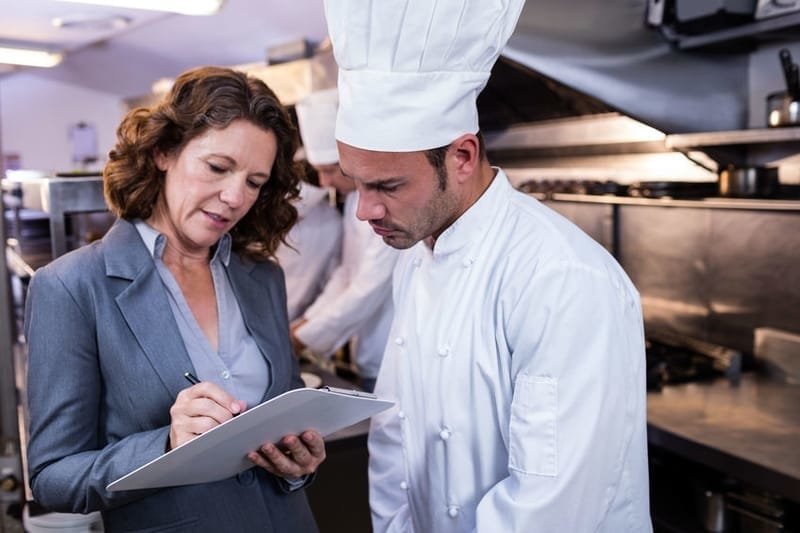
Food safety manager using task scheduling to maintain food safety

Food Safety Manager Secrets Using Task Scheduling When Understaffed

Due to lower seating capacity, reduced business other COVID-19 restaurant restrictions in Minnesota, food safety managers have at times been forced to run their businesses with fewer staff members than usual. While keeping an eye on labor costs will help keep Minnesota restaurants in business during trying times, we shouldn’t sacrifice routine food safety tasks in the process. By incorporating task scheduling into administrative duties, the food safety manager can provide an efficient means of keeping up with food safety concerns while protecting the business’s labor bottom line.

Food safety manager using task scheduling to maintain food safety
Image credit: Wavebreak Media Ltd via 123rf

Task Scheduling Tips for Short Staffed Food Safety Managers

In our interactions with food safety managers, we’ve heard a few common themes as to struggles finding time for some major aspects of their food safety duties. Some of the most common concerns deal with:

  • Inventory Control
  • Receiving and Evaluating Incoming Shipments
  • Employee Training

Food managers are taking more time on the line or in the dining room to compensate for a reduced payroll, and this might cut into the amount of time they have for inventory control and receiving shipments. Creating a detailed schedule involving tasks rather than simply shifts could help alleviate the pressure on food safety managers to complete certain tasks. A clearly defined task schedule will allow you to gain a full view of what needs to be done and give you the opportunity to adjust your schedules accordingly.

A defined task schedule can be as easy as scheduling a staff member 15 to 20 minutes a day to complete food safety maintenance tasks. For example, scheduling a food safety manager to inspect date markings on prepared product to ensure they are still safe to serve will ensure the task is accomplished much easier than if you simply leave it up to chance or hope for a slow moment in service. The same goes for receiving shipments and evaluating inventory. You almost always know what days your food suppliers drop off a delivery to your establishment. Keeping that in mind, make sure that your task schedule includes an extra employee on shipment days to ensure the order can be inspected and properly stored in a timely manner.

Employee training has also become an issue with limited time and sometimes limited restaurant capacity for staff. Training tasks can be scheduled outside of normal business hours in order to be in compliance with COVID-19 occupancy and social distancing rules. A better solution would be to use online tools and apps to handle training remotely when possible.

Do you use task scheduling to improve efficiency when understaffed?

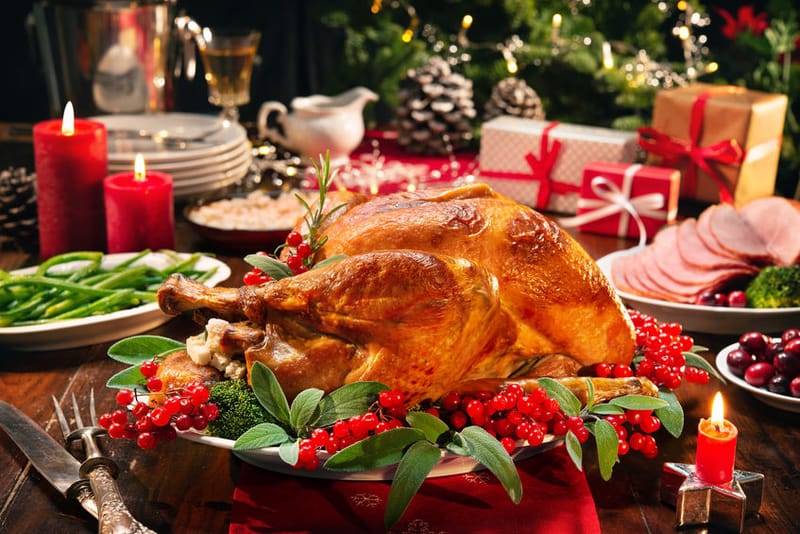
CFPM presentation of COVID safe holiday buffet

Valuable Tips For CFPMs Offering 2020 Holiday Buffets

In traditional times, the months of November and December see an increase in buffet dining options as larger groups congregate in restaurants and dining halls to celebrate the holidays. This holiday season is one like no other, so certified food protection managers have to take extra precautions not only to keep their food safe but abide by local COVID-19 restrictions. Let’s take a look at some steps Certified Food Protection Managers (CFPMs) can take if they choose to host a holiday buffet service.

CFPM presentation of COVID safe holiday buffet
Image credit: Alexander Raths via 123rf

Certified Food Protection Managers and Holiday Buffets

According to StaySafeMN hospitality guidance buffets are allowed as long as the establishment adheres to certain protocols. However, our first suggestion would be to assess whether it’s absolutely necessary to provide buffet service this season. With reservations required and limited seating capacity, your CFPM may wish to consider foregoing the holiday buffet for a more traditional sit-down service to better abide by StaySafeMN protocols. With the added restriction of required reservations, it’s possible that your guests can preorder their meals. This may streamline the process and reduce the risk of too many customers congregating around the buffet line.

If you do choose to offer a holiday buffet, you should take the following into consideration:

  • How will you enforce social distancing in buffet lines?
  • Will multiple guests use the same serving utensils?
  • How will sanitation protocols be put in place?

No matter the occasion, buffets tend to promote groups of people waiting in line and huddling in confined areas for extended periods of time. Even at 50-percent capacity, many restaurants may have trouble enforcing social distancing regulations. You may wish to have servers monitor the situation and release groups table by table to peruse the options at the buffet.

The use of common utensils presents a major dilemma when it comes to buffets. During regular buffet service, many unrelated guests may handle the same serving utensils. In order to avoid this common contact, we’d suggest pre portioning items on the table that guests can grab and go without digging into chafing dishes. While this may require guests to make multiple trips through the line, it reduces the risk of a potentially infected customer from spreading coronavirus through contact with utensils.

Finally, there should be rigid sanitation protocols in place. Assign specific staff members to sanitize common serving areas after each group has gone through the line.

Does your CFPMs have a plan for holiday buffet service?

Urgent New Stay Safe MN Guidance For Certified Food Protection Managers

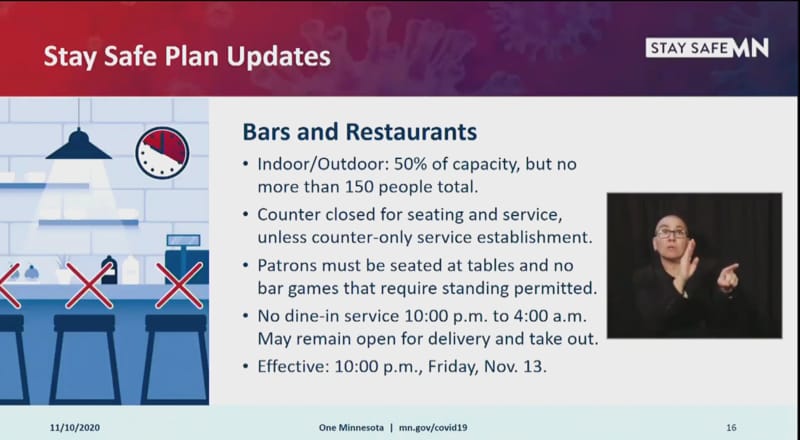
On November 10, Governor Tim Walz released new guidance for Certified Food Protection Managers at restaurants as part of the Stay Safe MN effort to control the spread of COVID-19. While there are only a few new restrictions on foodservice businesses, CFPMs should be aware that these new regulations will go into effect on Friday, November 13 at 10 PM. These changes include:

  • Changes in dine-in hours
  • Limits on games in bars and lounges
  • Reduction in indoor seating capacity
Governor Walz Nov 10, 2020 presentation re Stay Safe MN new regulations for Certified Food Protection Managers
Image credit: Office of Governor Walz

The first rule will affect most certified food protection managers at restaurants and bars as well as any other establishment that offers indoor dining. Starting Friday, dine-in service must end at 10 PM and cannot resume before 4 AM. Delivery, takeout and curbside service are still allowed during normal business hours.

Along with the new restricted hours, restaurants, bars and other establishments must require all patrons to remain at tables except to enter, exit or use restroom facilities. This new Stay Safe MN guidance specifically restricts any types of games that require standing and moving around in gaming areas. Bars and lounges should cover pool tables, remove dartboards, unplug arcade machines and prevent guests from participating in other game activities that require them to leave their tables and come into contact with other patrons.

Finally, indoor seating capacity must be reduced to 50 percent and no more than 150 patrons are allowed in large dining halls.

Hopefully, by following these new Stay Safe MN rules, certified food protection managers will keep doing their part to help reduce the spread of the coronavirus so we can make progress towards restoring our vibrant dining scene.