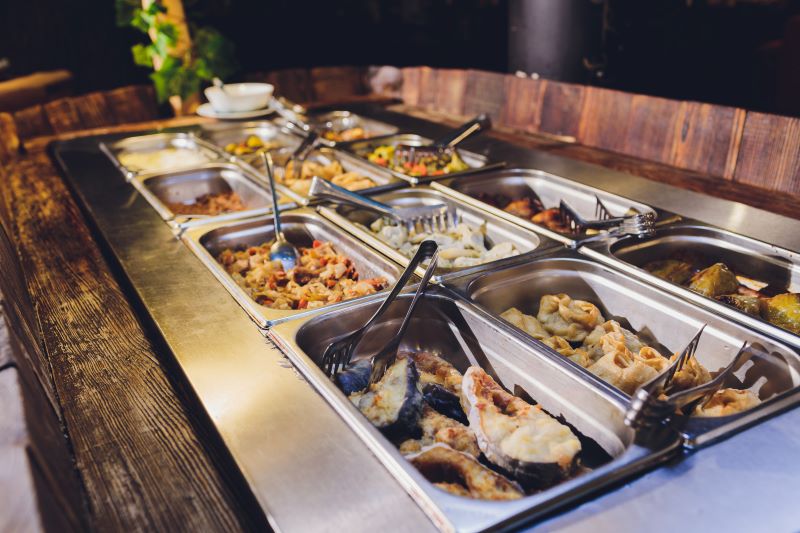
Keeping buffet items at safe temperatures is crucial for both food safety and quality. Proper temperature control prevents the growth of harmful bacteria and ensures that your guests enjoy a safe and delicious dining experience.
Temperature Control and Monitoring
Understanding the Temperature Danger Zone
The temperature danger zone, ranging from 41°F to 135°F (4°C to 60°C), is where bacteria multiply rapidly. Foods should not remain in this range for more than 2 hours, or 1 hour if the ambient temperature is above 90°F (32°C).
Image credit: vershininphoto via 123rf
Utilizing Food Thermometers for Precision
Use calibrated, digital food thermometers for accurate temperature monitoring:
Check hot foods every hour
Monitor cold foods every 2 hours
Record temperatures in a log for tracking and accountability
Regular temperature checks ensure that buffet items remain at safe temperatures throughout service.
Implementing Effective Heating Solutions
To keep hot foods at 135°F or warmer, use equipment such as:
Chafing dishes with fuel
Electric warming trays
Hot dishes such as meats, casseroles, and soups should be kept at a minimum temperature of 135°F to prevent bacterial growth.
Ensuring Cold Food Stays Cold
Maintain cold foods at or below 41°F (4°C) using:
Ice baths or nesting dishes in bowls of ice
Refrigerated or insulated serving units
Well-insulated coolers or containers
Replace ice as it melts and use shallow containers to help maintain cold temperatures.
7 Best Practices in Food Handling and Hygiene
Preventing Cross-Contamination
Separate raw and cooked foods during storage and preparation
Arrange foods strategically in the buffet area to prevent cross-contamination
Importance of Staff Training and Supervision
Develop a comprehensive training program on food safety and temperature control
Conduct regular refresher courses
Additional Tips for Keeping Buffet Items at Safe Temperatures
Use a food thermometer to regularly check the internal temperature of dishes
Keep extra hot items in warming ovens and cold items in refrigerators until needed
Discard perishable foods that have been left out for more than 2 hours (1 hour in hot weather)
By implementing these practices for keeping buffet items at safe temperatures, food managers can significantly reduce the risk of foodborne illnesses and maintain the quality of buffet offerings.
https://minnesota.safefoodtraining.com/2026/wp-content/uploads/2025/06/Remove-background-project-1024x614.png00Jeff Websterhttps://minnesota.safefoodtraining.com/2026/wp-content/uploads/2025/06/Remove-background-project-1024x614.pngJeff Webster2025-02-17 09:13:002025-02-24 08:38:59Expert Tricks for Keeping Buffet Items at Safe Temperatures
Preparing for your ServSafe certification? You’re not alone. Many food service professionals need to get their ServSafe questions answered to feel better about this certification from the National Restaurant Association.
The ServSafe certification is a crucial step in ensuring safe food handling practices in restaurants and other food service establishments. The exam covers critical topics such as foodborne illnesses, proper food storage temperatures, and personal hygiene practices.
Whether you’re wondering about exam format, study materials, or specific food safety protocols, we’ve got you covered. This guide will address the most common ServSafe questions to help you feel confident and prepared for your certification journey. Let’s dive into the key information you need to succeed in your food safety career.
The National Restaurant Association created ServSafe to address the growing need for standardized food safety education in the hospitality industry. Their goal was to reduce foodborne illnesses and improve overall food handling practices.
ServSafe offers various certifications, including the Food Handler and Manager certifications. These programs cover essential topics such as:
TCS Food safety
Preventing foodborne illness
Identifying common pathogens (e.g., Hepatitis A, Shigella spp)
Avoiding contamination and cross-contamination
Managing food allergens
Maintaining personal hygiene
The ServSafe curriculum is regularly updated to reflect the latest food safety research and industry best practices. It incorporates input from over 200 industry experts, including academics, operators, and trainers.
To obtain certification, you must pass an exam.
To prepare for your ServSafe exam, you can access practice tests and study guides. These resources can help you review important topics like food safety, personal hygiene, and proper cleaning and sanitizing procedures.
Remember, investing in your ServSafe certification is crucial for ensuring food safety in your workplace and advancing your career in the food service industry.
How hard is it to pass the ServSafe exam?
Of course, ServSafe questions about the exam are very common. The ServSafe exam is challenging but manageable with proper preparation. You have two hours to complete the test, which consists of multiple-choice questions covering various food safety topics.
To pass, you’ll need to achieve a score of 75% or higher. This means correctly answering at least 60 out of 80 questions on the ServSafe Manager Exam.
Preparing for the exam is crucial. Utilize study guides and practice tests to familiarize yourself with the content and question format. These resources can help you identify areas where you need more focus.
Key topics to master include:
Internal cooking temperatures for different foods
Proper receiving temperatures for deliveries
Time-temperature abuse prevention
Correct use of gloves and other personal protective equipment
Identifying and controlling pests like cockroaches
Remember, the exam questions may be worded differently, so read carefully. Answer based on the course material, even if it sometimes differs from common practices you’ve observed.
With thorough study and practice, you can confidently approach the ServSafe exam and succeed in obtaining your food safety certification.
How long does the ServSafe exam take?
The ServSafe Manager Exam typically takes 2 hours to complete. This 80-question test covers essential food safety topics like personal hygiene, cleaning and sanitizing, and internal cooking temperatures.
You’ll have ample time to answer all questions thoroughly. Some test-takers finish in as little as 15 minutes, while others use the full time allotted.
Is ServSafe the same as food handlers?
ServSafe and food handlers certifications are related but not identical. The food handlers certification is not required at this time in Minnesota.
What is a ServSafe Manager?
A ServSafe Manager is a food service professional who has completed specialized food safety training and passed the ServSafe Manager Certification Examination. This certification demonstrates your expertise in preventing foodborne illnesses and maintaining a safe food environment.
As a ServSafe Manager, you’re responsible for overseeing food safety practices in your establishment. Your duties include ensuring proper cleaning and sanitizing procedures, monitoring internal cooking temperatures, and maintaining appropriate receiving temperatures for food deliveries.
You’ll need to understand critical concepts such as:
To become certified, you must pass the ServSafe Manager Exam. The exam covers various topics, including foodborne illnesses, proper food storage, and sanitizing food-contact surfaces.
Preparing for the exam often involves using study guides and practice tests. These resources can help you familiarize yourself with the exam format and content, increasing your chances of achieving a passing score.
Does ServSafe expire?
ServSafe certifications are only accepted in Minnesota for 6 months for getting the state license although they don’t expire for 5 years. Make sure to do your paperwork within 6 months to get the MN Dept of Health credential.
The state license needs to be renewed every three years by taking an approved recertification course.
Key points to remember:
Keep your certification up-to-date to ensure compliance with local regulations
Stay informed about changes in food safety practices
Maintain your knowledge of critical areas such as personal hygiene, cleaning and sanitizing, and time-temperature control
By regularly renewing your ServSafe certification, you demonstrate your commitment to food safety and protect both your customers and your business.
Do i Need ServSafe and How long does ServSafe certification last?
ServSafe is one of several nationally accredited exams that allow you to get your Certified Food Protection Manager License. The National Registry of Food Safety Professionals exam is another that meets the requirements.
Your License from the MN Dept of Health once you pass the exam and apply is good for 3 years. The state only accepts exams that are 6 months old or newer for getting the certification.
There you have it! Some of the most common Servsafe questions have been answered.
https://minnesota.safefoodtraining.com/2026/wp-content/uploads/2025/02/ServSafe-Questions.jpg454800Jeff Websterhttps://minnesota.safefoodtraining.com/2026/wp-content/uploads/2025/06/Remove-background-project-1024x614.pngJeff Webster2025-02-03 20:53:562025-02-03 20:53:57Answering Your Top ServSafe Questions All in One Place