Expert Certified Food Manager Warning About Serving Raw Seafood

Expert Certified Food Manager Warning About Serving Raw Seafood

Earlier this month, we discussed the dangers of serving undercooked ground beef, even at customer request. This week, we’d like to look at a few issues that a certified food manager must know when they serve undercooked or raw seafood products.

Expert Certified Food Manager Warning About Serving Raw Seafood
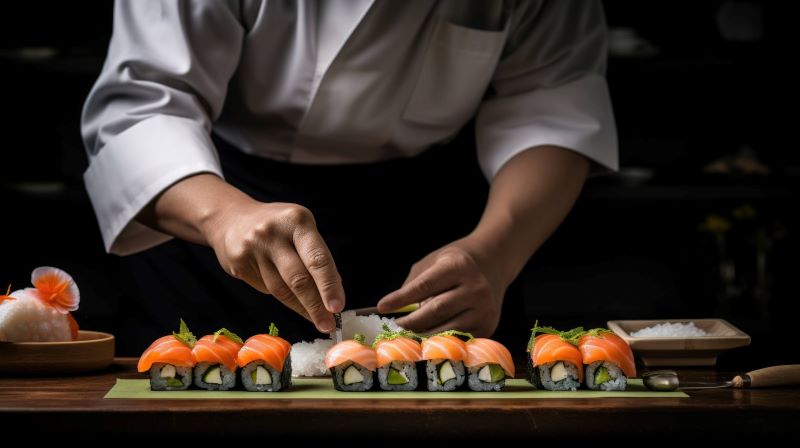
Image credit: ralph via pixexid

Certified Food Manager Tips for Properly Handling Raw and Undercooked Seafood

Raw seafood can be a susceptible product. A food manager must be vigilant to keep it safe whether you plan to serve sushi or fully-cooked fish and chips. If your facility prepares or serves any seafood product, you must serve the freshest fish and shellfish possible. Once you have received your product, keep it out of the danger zone and as cold as possible. We recommend storing your raw seafood product under ice, even under refrigeration.

Suppose you plan on serving raw or raw-marinated seafood products such as sushi, ceviche, lox, or seafood tartare. In that case, you must follow specific guidelines in the Minnesota food code. Except for certain types of fresh tuna, you must freeze any seafood you plan to serve uncooked first. This will help eliminate parasites. If your product is kept at a low enough temperature for an extended period, common parasites in most seafood will be killed. Make sure that you freeze your product before preparation at:

  • -4 degrees Fahrenheit for 7 days in your freezer
  • -31 degrees Fahrenheit for 15 hours in a blast chiller

There is an exemption to the rule if a certified food manager is serving raw or raw marinated tuna. Despite this, we strongly suggest serving the freshest and coldest product possible.

As we discussed last week concerning burgers, some guests will request their seafood served undercooked. The seafood should be cooked to a temperature of 145 degrees and should be held at that temperature for 15 seconds. While you may still serve undercooked seafood at your customer’s request, we strongly advise you to adhere to the Minnesota food code when serving cooked seafood.

Menu Warning regarding Seafood

Finally, if a certified food protection manager plans to serve raw seafood, you must identify and inform your customers that your menu items are raw or undercooked. As with steaks and burgers, this can be quickly done by placing an asterisk next to the menu item, referring to a warning at the bottom of each menu page.
Challenge of thermometer cross-contamination for CFPMs

The Challenge Of Thermometer Cross-Contamination For CFPMs.

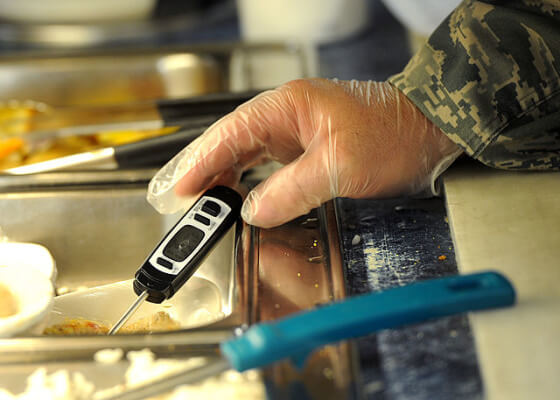
Certified food protection manager classes teach that using an internal probe thermometer is the best way to ensure food is cooked to the proper temperature. While a CFPM’s thermometer is one of the most essential tools in keeping your food safe, it poses an ominous cross-contamination risk that could lead to foodborne illness.

Challenge Of Thermometer Cross-Contamination For CFPMs.
Image credit: commons.wikimedia.org

Reducing the Risk of Cross-Contamination from a CFPM’s Probe Thermometer

Cross-contamination is a constant risk in any kitchen. We have three simple tips to ensure your probe thermometer is safe from this risk.

  • Sanitize your probe after each use
  • Always store your thermometer in its storage sleeve
  • Keep the storage sleeve clean

The probe thermometer is in constant contact with potential contaminants. It is used into every protein, ready-to-eat food, and chilled item. Whether someone inserts it into undercooked chicken, chilled soup for storage, or hot items in the cafeteria, sanitizing it after each use is vital. Remember, your thermometer is not clean just because it looks like it is.

Secondly, CFPMs should always store the probe monitor correctly. Never store your thermometer loosely on a countertop, in food, or in any location where potential contamination could occur. Finally, it is essential for CFPMs to keep your thermometer’s storage sleeve clean to minimize the cross-contamination threat. It is possible for bacteria to form in the sleeve and transfer onto the probe when it is not in use.

Remember to Calibrate Your Thermometer Regularly

While not necessarily a cross-contamination issue, we feel now would be a good time to remind all CFPMs to check and calibrate their thermometer often. To do this, set your thermometer to 32 and submerge the probe in a large glass of crushed ice and water, then give the thermometer time to calibrate

Thermometer cross-contamination is only one risk CFPMs must deal with. There are many small cross-contamination risks from utensils in every facility. At Safe Food Training, we want to provide tips on preventing even the slightest danger. What are the cross-contamination risks you feel are being overlooked in your facility?

MN Food Safety And The Medium Rare Cheeseburger

We stay connected to the local food industry. During our visits to several restaurants we’ve noticed an alarming trend. Many restaurants are serving raw and undercooked animal products, but may not be doing so safely. This week, we’ll begin a series of articles aimed at helping you deal with raw and undercooked animal proteins. For the first article in the series we’ll discuss how you balance MN food safety with the ubiquitous request for a medium rare cheeseburger.

food safety certification and medium rare Cheeseburger
Image credit: Flickr

The Medium-Rare Cheeseburger Food Safety Dilemma

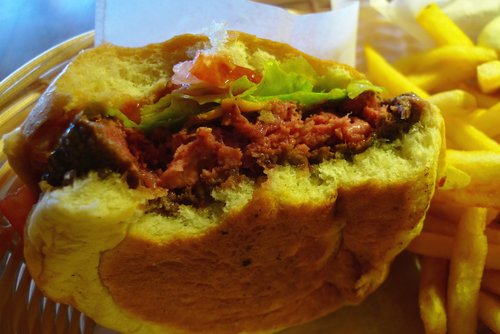
On more than one occasion, the waiter has asked us if we would like our cheeseburger cooked with or without a little pink. The first issue we’d like to deal with is what temperature pink actually is. Pink is not a temperature. It is in fact just a color. There can be many factors that change the internal color of your beef patty. The only accurate way to find the internal temperature of a burger is to use a probe thermometer. If you have completed a food safety certification course, you will know that a beef patty does not meet the cooked criteria unless it reaches an internal temperature of:

  • 150 degrees for one minute
  • 145 degrees for thee minutes

We are often asked by Food Safety Managers if it is legal to serve n undercooked cheeseburger that is not cooked according to Minnesota Food Code requirements. According to the current regulations it is acceptable to serve raw or undercooked animal product if:

  • A customer requests it
  • The menu clearly states that the product is undercooked
  • An asterisk next to the menu items directs the consumer to a footnote. Which states the dangers of consuming undercooked animal product.

Some of the language in the regulations can be confusing. Since we are specifically discussing undercooked burgers, we’d like explain how to deal with ground beef patties. If you’re comfortable with honoring a consumers request to serve an undercooked cheeseburger, then you legally may do so. To make sure that you are in full compliance with the law, include the asterisk and warning of the dangers of consuming raw or undercooked beef next to every burger item on your menu.

Solving the Dilemma

We strongly suggest that you do not offer a medium rare or undercooked burger on your menu. In fact,  we’d suggest that your servers do not even ask if your guests how they want their burger cooked.

If you are uncomfortable with serving an undercooked burger, simply explain to the guest that you cannot honor their request. Because your establishment adheres to the Minnesota Food Code standards.


Certified Food Managers Get Remarkable Results From Daily Log

Certified Food Managers Get Remarkable Results From Daily Log

The operation logs in most food production outlets are typically reserved for management communications. However, we believe that regular written communication between certified food managers and staff, such as a daily log, can be highly effective in promoting food safety and increasing productivity.

Certified Food Managers Get Remarkable Results From Daily Log

Image Credit: lyashenko via 123rf

How Certified Food Managers Can Effectively Use a Daily Log

As a MN certified food manager, you are often busy and may not be able to address issues immediately. Sometimes, simply being informed that there is a problem is insufficient. It is important to keep a record of issues. Important concerns will not be overlooked or put on the back burner in this way. They will not be forgotten. There may also be times when an issue arises when you are not at work. A daily log provides the opportunity for your staff to let you know what is happening rather than leaving a problem unaddressed. The three categories that we think are important for your staff to document are:

  • Food safety issues
  • Equipment malfunctions
  • Health and safety hazards

It is essential for your staff to understand that they cannot ignore food safety concerns. Giving them the responsibility to alert a supervisor and record the problem will help them fully understand food safety procedures. It is essential for your staff to understand that they cannot ignore food safety concerns.

There are many times in this business when a refrigerator stops working. The fan in an oven quits or a deep fryer fails to hold a consistent temperature. There may be warning signs indicating that something is wrong with your equipment, but you might not receive notification until it is too late. If your staff could record abnormal equipment performance. You may be able to take care of the problem with an easy repair. This will save you money instead of spending it on replacing your expensive equipment.

Health and Safety Hazards

The last item is a vital one to monitor in your establishment. Your staff will feel comfortable and secure if they understand that you care about their working conditions. While employee safety should be addressed immediately, it is a good idea to give your employees an outlet to express their concerns when you are not on the clock.

There are many other uses for a daily log in the food industry. Many establishments use them as a communication tool. The opening and closing crews use the tool for communications. The outlets with multiple managers also use it to keep on the same page. At Safe Food Training, we would like to hear how you use your daily log to improve the way your business operates.