Minnesota Food Managers Guide to Labeling Retail Products

Minnesota Food Manager’s Guide to Labeling Retail Products

If you’re a Minnesota food manager who works at a facility that prepares ready-to-eat foods for retail sale or creates food items consumers will purchase and cook at home, you should be aware of the proper procedures for labeling your packaged products. The Minnesota food code has a few labeling requirements for prepackaged foods that must be adhered to.

Minnesota Food Managers Guide to Labeling Retail Products
Image credit: Flickr – Michael Steeber

Packaged Product Labeling for Minnesota Food Managers

Prepared foods packaged for retail sale require labels that alert purchasers of the contents inside the package. These labels are required to protect consumers and help them make nutrition judgments about the foods they consider purchasing. Some key elements you must print on your label include:

  • Identity or name of product
  • Net quantity of contents
  • Ingredient list
  • List of major food allergens
  • Name and address of producer
  • Nutritional information

All of these items must be clearly labeled. Your potential customers should understand exactly what it is they are buying, how much is included in the package and what ingredients are included in the food product. Not only are these details informative to the consumer, they’ll actually help you sell and market your product. If you can’t adequately identify the contents of your product, how’s the general public going to identify what they’re purchasing? Misleading or confusing labels may cause potential customers to choose a different product.

Beyond ingredients, you must clearly identify major allergens. This is a must. Not only must you list allergens in your product, you should do so in a clear manner where those afflicted with allergies will clearly see if there are any ingredients they cannot consume. We suggest listing allergens in your ingredient list as well as including a clearly visible second list of allergens and potential allergens your product may have come in contact with. The allergens that must be listed are:

  • Milk and dairy
  • Eggs
  • Fish
  • Shellfish
  • Tree nuts
  • Peanuts
  • Soy
  • Wheat and flour

Depending on the size of your business, you may also be required to post nutritional information on your label. Some products packaged by small businesses may be exempt. For more information on exemptions, check out the FDA guidelines for nutritional fact labeling exemptions.

Finally, food managers must include the name and address of your business on the labeling of packaged products. This not only helps customers recognize your brand name so they can purchase your product again, but it’s also required to identify the source of contamination in the event of a foodborne illness outbreak.

Are you a Minnesota food manager that specializes in retail sales? If so, what food safety topic would you like to see us pay closer attention to?

Certified Food Protection Manager Fire Procedures

Certified Food Protection Manager Procedures for Fires

Fires are something we never like to think about, but something we should prepare for. The kitchen is a hot place, there’s plenty of open flame, electrical systems running at full capacity and other risks that may result in a fire that causes damage to your kitchen or other parts of your restaurant. So what procedures should a certified food protection manager put in place to address a fire in the kitchen?

Certified Food Protection Manager Fire Procedures
Image credit: cc-by-sa/2.0 – © M J Richardson – geograph.org.uk/p/6181023

Fire Procedures for Certified Food Protection Managers

Certified food protection managers should have a protocol for dealing with fires. If you don’t already have clear procedures for what to do in the event of a fire, sit down with your staff and develop a plan. Your plan should answer the following questions:

  • Is the fire containable?
  • Should I extinguish or evacuate?
  • When is it safe to reopen?
  • What product is salvageable?

If you do have a fire, chances are it won’t be as devastating as the worst-case scenario, but you should still remain calm and take action. If your fire is easily extinguishable, make sure you use a non-water based extinguisher. Oil and grease are common factors in kitchen fires, and water will cause the fire to spread. If you need help developing a plan for what to do in the event of a fire, contact your insurance agent or local fire department. In many cases, a representative from one of these agencies will gladly provide an on-site inspection and offer advice.

After your fire is out, determine whether it is prudent to continue operations. If you’ve had a fire which requires the use of your fire-suppression system or assistance from the fire department, you may need clearance from the local fire marshal and health department to resume operations.

Before you begin operations once again, food safety must be at the forefront of your decision. Take the following steps before returning to normal operating procedures:

  • Inspect containers for fire damage
  • Dispose of food in storage and refrigeration close to active fires
  • Dispose of product left in the danger zone
  • Clean and sanitize all utensils and surfaces affected by smoke

Cans heated by fire should be thrown away. Food inside cans may begin to cook at low temperatures causing bacteria to grow. Open produce and other product in storage areas that have seen smoke should also be disposed of, including the insides of refrigerators. Many industrial refrigeration units are not air tight, so product inside can become contaminated by smoke. If you lose electricity or food becomes warmed by the fire, it must be disposed of. If any product spends excessive time between 41 and 135 degrees, it must be disposed of. The old adage should apply here: When in doubt, throw it out.

Do you have a plan in the event of a fire?

Food Safety Training for Cooking Whole Turkeys

Online Food Safety Training for Cooking Whole Turkeys

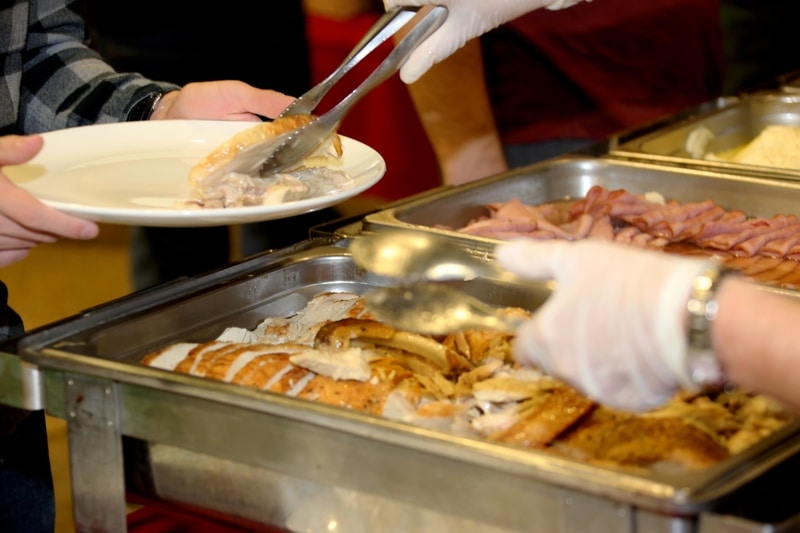
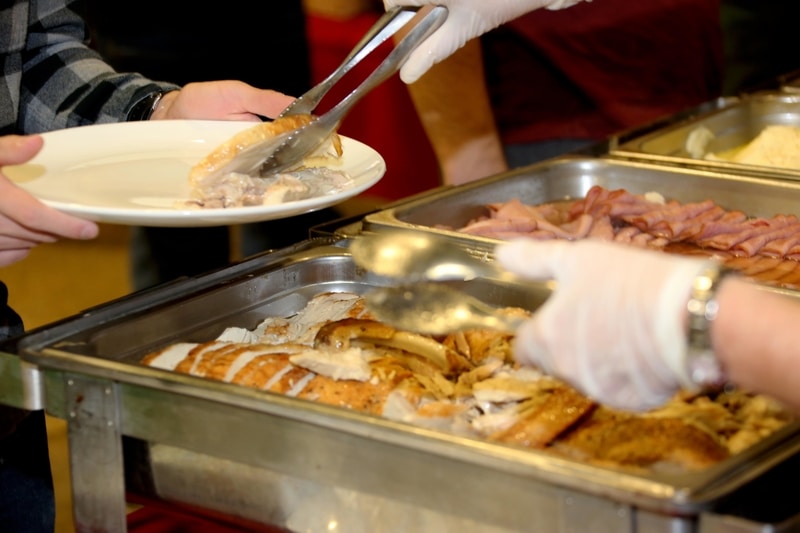
Thanksgiving is here and that means it’s time to overindulge on turkey, mashed potatoes, gravy and pumpkin pie, but the last thing you want to include in your festivities is a salmonella outbreak. Whole turkeys can take quite some time to cook and it may be difficult to achieve safe temperatures while keeping the meat moist and flavorful. This week, we’ll look into what food safety training recommends to cook a tasty turkey without a side of foodborne illness.

Food Safety Training for Cooking Whole Turkeys
Image credit: US Marine Corps Air Station Cherry Point

Food Safety Training tips for Properly Cooking Whole Turkeys

Whole turkeys can be tricky to cook properly because of the thickness of the breast. One part of the turkey can be cooked perfectly, but the center can be left an undercooked breeding ground for bacteria. In order to prevent this scenario, we have three food safety training tips for a properly cooked turkey:

  • Use fresh or fully thawed birds
  • Check internal temperature properly
  • Prepare stuffing separately

Partially thawed turkeys are a food safety nightmare. While the outer layers may feel thawed and ready to cook, the center of the thickest parts of the bird may still be frozen. This can add to the cooking time of larger turkeys. It can also result in vastly overcooked outer layers while still leaving the thickest section undercooked. Half-thawed birds may also cause complications when attempting to gauge the internal temperature. Outer layers may reach the proper temperature of 165-degrees well before the center, throwing off your thermometer’s readings for the innermost layers.

Many commercially sold turkeys come with a small probe that will supposedly let you know when your bird has reached a safe serving temperature. Our advice to you would be to remove this probe before cooking and place in the nearest garbage receptacle. The only accurate way to assess the internal temperature of large turkeys is to use a bi-metallic stem thermometer. Insert your probe thermometer into the thickest part of the turkey breast as deep as possible without touching any bones. If your thermometer reads 165 degrees for at least 15 seconds, you can be confident that your turkey has been fully cooked.

One final note concerning food safety training for turkey stuffing. Stuffing your turkey before cooking will increase the amount of time that it takes to fully cook your turkey and pose a salmonella risk. There is a very real possibility that your stuffing will not reach a high enough temperature to kill any bacteria at the same time as the rest of your turkey, so we strongly suggest you cook your stuffing separately.

Happy Thanksgiving from all of us at !

Food Manager in Walkin Freezer

Why do ServSafe Food Managers Set Freezers to Zero Degrees?

According to the Minnesota Food Code, all frozen food must remain frozen until ready to use and the USDA recommends setting freezers to zero degrees Fahrenheit. This got us wondering; why zero? Is zero a scientifically determined number, or is it in the correct temperature range and just happens to be a good round number? Will two degrees work just as well? Or maybe -12.5? This week we’ll take a good look at freezer temperatures and how zero degrees became the standard for ServSafe Food Managers.

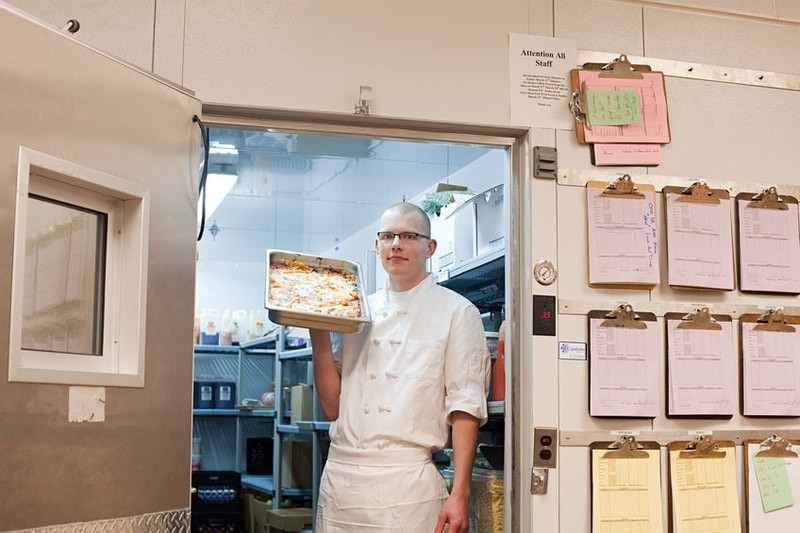
Food manager in walk-in freezer
Image credit: 123rf

ServSafe Food Managers and Freezer Temperatures

The history of the standard of zero degrees goes back to the 1930s when the American Fruit and Vegetable Coalition advocated zero degree temperatures because it was, in fact, a round number. Prior to this, freezing recommendations had been set at 14 degrees Fahrenheit. Science didn’t even come into the conversation until much later.

According to the laws of thermodynamics and the use of a mathematical logarithm known as the Van’t-Hoff equation, scientists much smarter than us were able to show that there is a uniform lowering of the velocity of chemical reactions in any substance as temperatures decrease. To break it down in terms those of us without PhDs in chemistry and physics can understand, once the temperature reaches zero degrees, the molecules and atoms in frozen product slow to the point where there is little perceptible movement. This means that bacteria cease to grow and there is very little loss of nutrition in foods frozen below zero degrees. Using this method, it has been determined that the ideal range of freezer temperatures is between zero and -22 degrees Fahrenheit.

So now that we know why ServSafe food manager training tells us to keep freezers at zero degrees, why don’t we go further and freeze product closer to the low end of the range?

First, while bacteria are held at bay indefinitely, that doesn’t mean that there isn’t a risk of freezer burn. Freezer burnt product may still be safe to eat from a food safety standpoint, but it sure isn’t pleasant from a taste and texture standpoint. Long exposure to extremely low temperatures will keep your food safe to eat but will tarnish its quality.

Finally, it’s unwise from an efficiency and energy use standpoint. Keeping your freezer at the upper end of the freezing range and closer to zero degrees will use a lot less electricity and keep utility costs down.

As a ServSafe food manager, what temperature do you set your freezer?