Posts

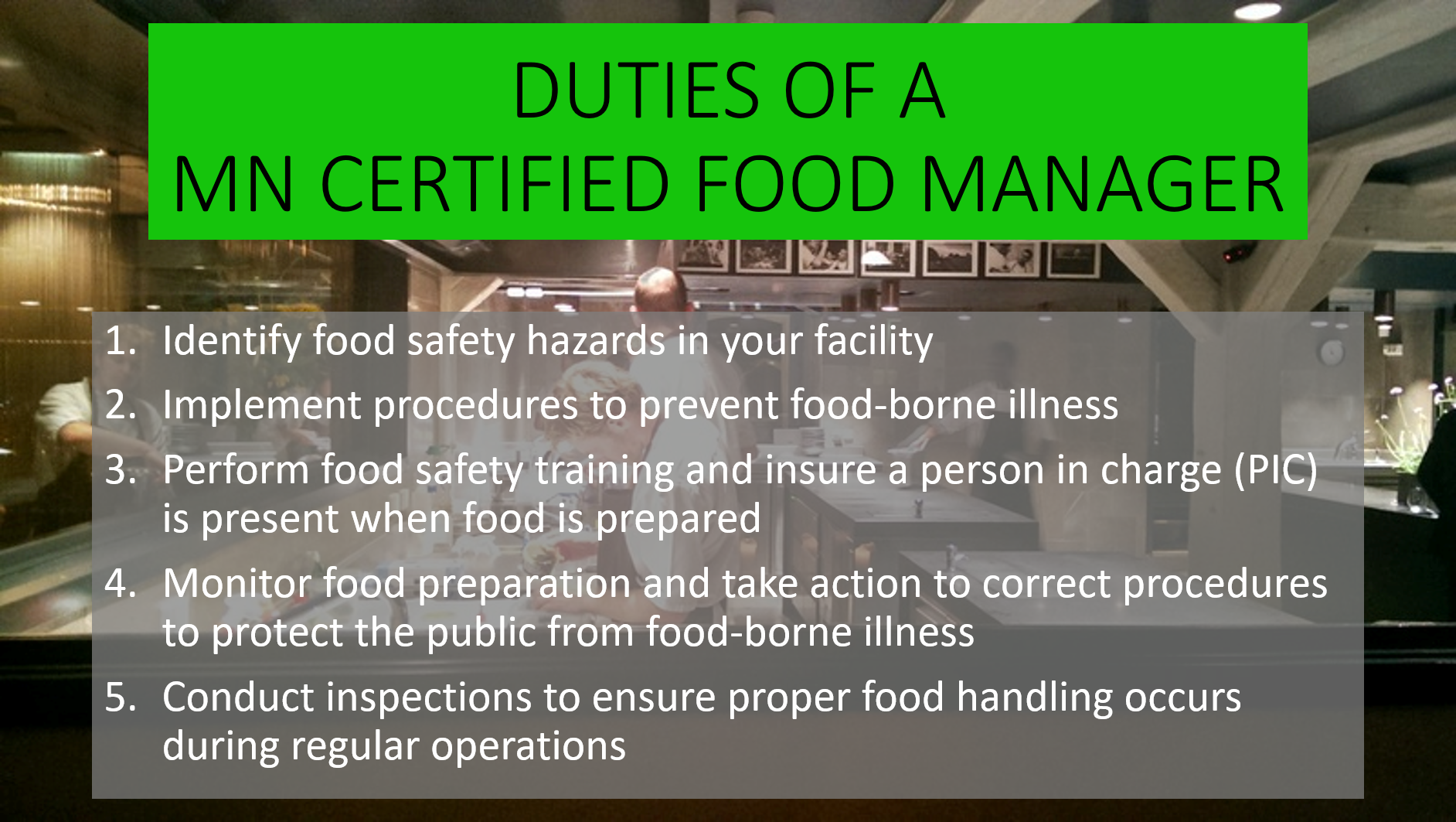
Duties of a MN Certified Food Manager

What Are The Duties Of A MN Certified Food Manager?

Whether you have the title of kitchen manager, executive chef or food and beverage supervisor, we know that you have a myriad of duties that require your constant attention. You write budgets, calculate food costs, hire staff and train employees. On top of that, are the duties of a MN certified food manager. The state has outlined very specific responsibilities that help you keep the food you serve safe.

Duties of a MN Certified Food Manager

On the Job Duties of a MN Certified Food Manager

Once you complete training and gain your food manager certificate, the Minnesota Department of Health requires you to perform the following duties:

  • Identify food safety hazards in your facility
  • Implement procedures to prevent food-borne illness
  • Perform food safety training and insure a person in charge (PIC) is present when food is prepared
  • Monitor food preparation and take action to correct procedures to protect the public from food-borne illness
  • Conduct inspections to ensure proper food handling occurs during regular operations

As a MN certified food manager, your obligations go beyond the day-to-day operations of your business, and you must keep the food your operation serves safe. Identification of hazards is your first step towards food safety, but you must act on your observations. Nearly every one of the requirements for food managers can be seen as a reaction to the hazards that you have identified.

Proper implementation of procedures goes a long way to preventing the spread of food-borne illness. The key to effective food-safety protocols include training, monitoring and a keeping written track record for reference. It does no good to simply train one or two employees and let your procedures spread from there. Take the time to train your entire staff on proper food-handling techniques, especially those that might be unique to your establishment and the type of product you serve or sell.

Finally, you must follow up on your identification and procedure implementation by monitoring day-to-day operations to ensure procedures are followed properly. Conducting periodic self-inspections of your facility is also a great tool to monitor how food is handled. Be thorough when you conduct your self-inspection. Act as if you were your local health inspector and check every aspect of your facility. Conduct a verbal review with your employees and make sure that any potential hazards are being dealt with properly.

Do you have any tips for keeping track of your duties of a MN certified food manager?

ServSafe MN news- Norovirus outbreak at Minnehaha Academy

Breaking ServSafe MN News: The Norovirus Strikes Local School

ServSafe MN News: According to a report on MPR Radio an outbreak of the Norovirus caused Minnehaha Academy to close its doors for several days after dozens of students and faculty members fell victim to the illness. With such a large outbreak, the facility felt it necessary shut its doors in order to prevent further spread of the virus and ensure the safety of its students.

ServSafe MN news- Norovirus outbreak at Minnehaha Academy

Photo credit:Ed Kohler via Flickr.com

Cleaning Up After a Norovirus Event

The Norovirus is one of the most contagious food-borne illnesses. We recently covered this topic in a previous article, but, just to review, some of the Norovirus symptoms include diarrhea, vomiting and dehydration. While rarely life threatening, we cannot ignore the severity of any Norovirus outbreak.

In cases such as the one which occurred at Minnehaha recently, a major outbreak requires major cleanup. The Norovirus spreads from unwashed hands, saliva and contact with other bodily fluids that have been infected. It can live on utensils, hard surfaces and contaminated food for an extended period of time. That means that after an outbreak nearly anything can be affected.

If your facility experiences outbreak of the Norovirus, we urge you to take the following steps:

  • Clean and sanitize all food preparation surfaces
  • Dispose of potentially contaminated food product
  • Wash and sanitize all utensils and serving wear
  • Work with your local health department to facilitate cleanup

Remember, that the best way to prevent an outbreak of any type of food-borne illness is diligence. Remind your staff not to work while sick, and if they have had Norovirus symptoms to refrain from working for several days after symptoms have disappeared. The Norovirus can still be active after a victim has appeared to have recovered. Use good sense and sanitize preparation surfaces frequently, and review proper hand washing procedures with your team.

If you would like to schedule a ServSafe MN review of how to prevent food-borne illness, we can help with both instructor led and online courses tailored to your specific facility.

Norovirus and Online ServSafe Training

Norovirus and Online ServSafe Training

The Norovirus is covered thoroughly in online ServSafe training, it sickens more people each year than any other food-borne illness cause. Since this virus mainly spreads through contact with an infected food worker rather than a natural occurrence in food product, there are numerous challenges in preventing it from contaminating prepared food product.

Norovirus and Online ServSafe Training

Image credit: by Debs (ò?ó)? via Flickr

Online ServSafe Training Guide to the Norovirus

The most common source of the Norovirus comes from human contact or the failure to properly sanitize work stations after use. The usual ways that this pathogen comes into contact with food includes:

  • Contact with microscopic traces of infected blood, vomit, or other bodily excretion
  • Contact with contaminated surfaces
  • Contact with saliva or unwashed hands of an infected person

There are two lessons that are covered in our online training that should be apparent from looking at these regular causes of the Norovirus. First, do not work while sick. The chances of spreading the Norovirus increase when ill workers handle food product. The possibility also exists that your staff could still spread the virus after symptoms have dissipated. The Norovirus hangs around in the infected people’s blood and digestive systems for a few days after they have appeared to have recovered, so it may be necessary to take a few extra sick days after contracting this illness.

The second important lesson to learn is one that should be practiced even if there is little chance of spreading the Norovirus. Hand washing must be done diligently and properly after using the restroom, eating, smoking or participating in any activity that causes you to touch your mouth or other unsanitary areas of your body. Steps also should be taken to see that there is no barehanded contact with food product. Make sure that you have plenty of utensils and food-service gloves available so that potentially infected hands stay away from your product.

While the main causes of Norovirus poisoning come from human contamination, our online ServSafe guide would be incomplete if we did not mention potential hazards in food before it reaches your facility. There is a chance that an infected farmer or other worker could handle raw fruits and vegetables before they reach your business. In this case, you must make sure that all raw produce is properly washed and stored. Shellfish can also naturally absorb the Norovirus from the water that they are harvested from, especially in the warmer months of the year. Shellfish should be prepared properly and care should be taken to reduce the risk of cross-contamination with other food product.

Food Safe Training Guide to E. coli

Food Safe Training Guide to E. coli

Over the past few months, we’ve run a series of articles focusing on the most common causes of food-borne illnesses and product recalls. This month, we continue our series with a look at how E. coli and the related STEC bacteria strains are spread and how you can prevent your guests from consuming contaminated food.

Food Safe Training Guide to E. coli

Food Safe Training and E. coli

E. coli poisoning recently garnered national attention with a nationwide outbreak traced to Chipotle restaurants. Even with this high-profile case, E. coli is no longer ranked as a top-five cause of food-borne illness according to the CDC. It is, however, still very important to understand how to reduce the risk of spreading illness due to E. coli because according to this same study, this bacterium causes over 2,000 hospitalizations each year.

In order to control the spread of E. coli, we must first know where it comes from. The STEC strains may exist in:

  • Undercooked ground beef
  • Unpasteurized milk and cheese
  • Unpasteurized juices
  • Alfalfa sprouts
  • Unwashed vegetables

If you have worked in the food industry for a length of time, you know that you must cook ground beef thoroughly in order to kill E. coli, but some of the other causes might come as a surprise. We have discussed the dangers of serving raw milk products numerous times in the past, and we can now add the potential for E. coli poisoning to the list of risks involved with consuming unpasteurized dairy products.

Raw fruits and vegetables pose a threat that often goes undetected. While the STEC bacterium does not naturally occur in raw produce, exposure to cross contamination is a real risk. E. coli naturally occurs in the digestive tract of livestock, and it spreads through contact with the animal, its feces or raw milk. Produce can be contaminated simply by a farmer walking through a cow pasture and transferring it to the soil raw vegetables grow in by wearing the same shoes. The same can happen with farm equipment on a much larger scale.

To keep your vegetables safe, especially leafy greens and sprouts, we urge you to wash all produce that you receive before serving it to guests or incorporating it into other menu items.

Next month, our series will continue as we tackle the number-one culprit of food-borne illness, the easily spread norovirus.