Recall Effects Certified Food Protection Managers

Another Romaine Recall Affects Certified Food Protection Managers

Here we go again. Near the end of November, the CDC reported 40 people in 16 states have fallen ill due to E.coli found in romaine lettuce grown in the Salinas growing region in California. Due to the vast amount of lettuce grown in this region, the FDA strongly urged consumers to dispose of all romaine in any form if there was any uncertainty as to where the lettuce was grown. This means that grocery stores, foodservice suppliers and restaurants were unable to use whole heads of romaine, hearts of romaine, chopped romaine or salad mixes that contain romaine. This left a multitude of affected certified food protection managers scrambling to find alternatives, especially considering the recall occurred just before a very busy Thanksgiving week.

Recall Effects Certified Food Protection Managers
Image credit: BlackRiv, Bruno Glätsch, Pezibear from Pixabay and Anita Hart from Flickr

Romaine Alternatives for Affected Certified Food Protection Managers During Recall

Romaine is a staple in the food industry. Due to its crisp texture and traditional use in Caesar salads, it’s always heavily in demand, but what can CFPMs do when it’s suddenly unavailable?

First thing certified food protection managers must do is inform guests that romaine lettuce is unavailable. This can be as easy as including a notice in your menus or in a visible location before guests are seated or served. Many guests may not follow the news and may have a negative reaction to being served a different type of product than what is listed on your menu.

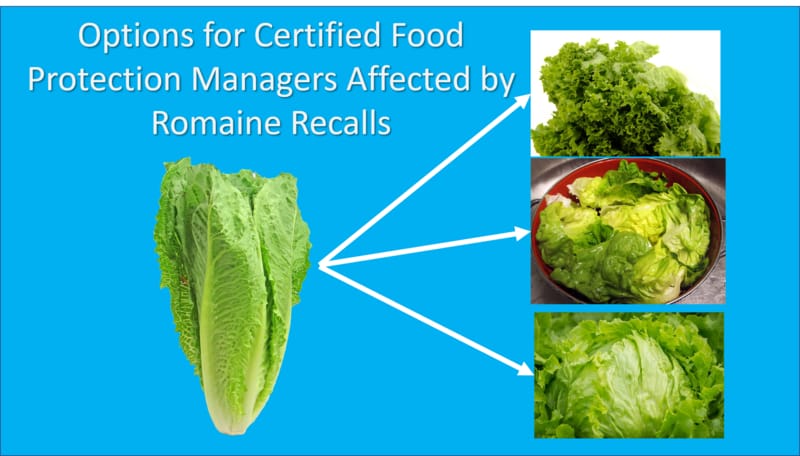
Secondly, you may want to find as close of an alternative as possible. With the latest recall happening just before Thanksgiving, we’ve heard stories from foodservice professionals that even other forms of lettuce had become scarce due to demand for a romaine replacement and an abundance of caution concerning all produce from the Salinas growing region. While nothing really has the crunch and flavor of romaine, there are a few potential alternatives:

  • Iceberg Lettuce
  • Butter Lettuce
  • Green Leaf Lettuce
  • Leafy Greens

Of the above alternatives, none will have the crunch factor of a crisp romaine heart, but iceberg, butter and green leaf varieties of lettuce will still have similar flavors and could provide an adequate substitute until romaine once again available. We’ve heard of some certified food managers thinking outside the box and replacing some menu items with different salads containing leafy greens such as kale, bok choy and spinach.

We’re interested in how certified food protection managers have been affected by recent romaine recalls. What alternatives did you use during the latest romaine recall?
smarter food safety product traceability

Applying Product Traceability Software for Smarter Food Safety

Back in October, we covered a public forum put on by the FDA concerning the future of food safety. Just recently, the FDA has released the transcripts from nearly every session, giving those of us in the food safety training industry plenty of material to dig through concerning their vision for the future of food safety in our country. This week we’d like to take a look at a few of the ideas presented at the New Ara of Smarter Food Safety meeting involving the use of product traceability technology to quickly find the source of foodborne illness outbreaks.

Smarter Food Safety product traceability
Image credit:
mavoimage via 123.rf and United States Department of Agri via Flickr

Achieving Smarter Food Safety in the Supply Chain Using product Traceability Software

When it comes to foodborne illness tracing, it would be ideal if the FDA and CDC could immediately identify the source of contamination. For example, if someone consumes tainted lettuce in Minnesota and becomes ill, the FDA could find out the source of the contaminated product in New Mexico and take immediate action. This isn’t exactly possible with the way the supply chain works today.

Raw food products come from many different parts of the country, and certified food managers may receive a shipment of greens from California one week and Arizona the next. In fact, there are many occasions where the warehouse run by your food supplier has very little information about where your product originated. In the case of an outbreak, it takes some time to figure out exactly where the tainted product came from, potentially leaving the door open for the further spread of illness.

The big question is; How can we solve this?

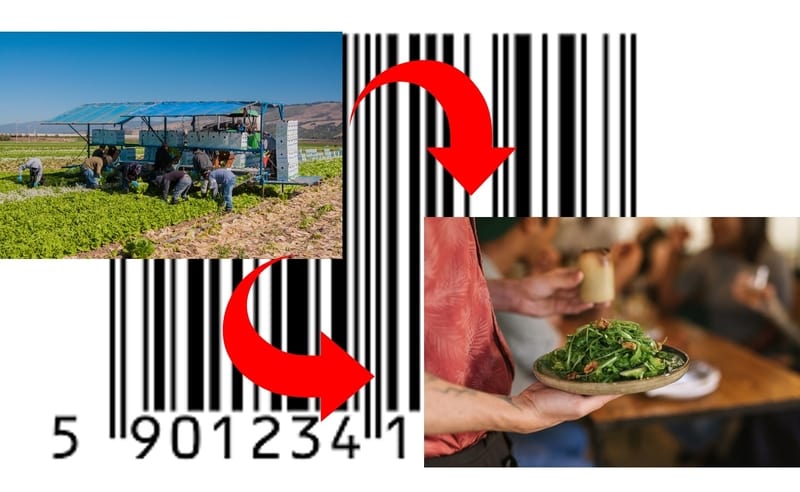
During a Smarter Food Safetypresentation on product traceability, a spokesperson from the software company FoodLogiq suggested that advanced software could be used to create a roadmap for the entire supply chain. This would mean that software could be used at all levels of the supply chain from growers and farmers to individual food service facilities such as restaurants and retail producers to instantly tell you the travel history of any given product from farm to fork. But is this feasible?

We think this is a great idea, but it would take time to implement. As it stands now, there is no one high-tech method being endorsed for product traceability. That means one shipper could use a different system than another, and along the way product can’t be traced due to conflicting systems. There also appears to be little incentive for smaller operations to use this software. Small one outlet restaurants and independent farmers have enough on their plate without having to research, purchase and maintain tracking software.

If the FDA Era of Smarter Food Safety vision can come up with a product traceability standard to track nearly every single ingredient, foodborne illness outbreaks can be easily contained. Do you think an overarching tracing system could be implemented to track product and stop outbreaks before they become widespread?

Certified Food Protection Manager Fire Procedures

Certified Food Protection Manager Procedures for Fires

Fires are something we never like to think about, but something we should prepare for. The kitchen is a hot place, there’s plenty of open flame, electrical systems running at full capacity and other risks that may result in a fire that causes damage to your kitchen or other parts of your restaurant. So what procedures should a certified food protection manager put in place to address a fire in the kitchen?

Certified Food Protection Manager Fire Procedures
Image credit: cc-by-sa/2.0 – © M J Richardson – geograph.org.uk/p/6181023

Fire Procedures for Certified Food Protection Managers

Certified food protection managers should have a protocol for dealing with fires. If you don’t already have clear procedures for what to do in the event of a fire, sit down with your staff and develop a plan. Your plan should answer the following questions:

  • Is the fire containable?
  • Should I extinguish or evacuate?
  • When is it safe to reopen?
  • What product is salvageable?

If you do have a fire, chances are it won’t be as devastating as the worst-case scenario, but you should still remain calm and take action. If your fire is easily extinguishable, make sure you use a non-water based extinguisher. Oil and grease are common factors in kitchen fires, and water will cause the fire to spread. If you need help developing a plan for what to do in the event of a fire, contact your insurance agent or local fire department. In many cases, a representative from one of these agencies will gladly provide an on-site inspection and offer advice.

After your fire is out, determine whether it is prudent to continue operations. If you’ve had a fire which requires the use of your fire-suppression system or assistance from the fire department, you may need clearance from the local fire marshal and health department to resume operations.

Before you begin operations once again, food safety must be at the forefront of your decision. Take the following steps before returning to normal operating procedures:

  • Inspect containers for fire damage
  • Dispose of food in storage and refrigeration close to active fires
  • Dispose of product left in the danger zone
  • Clean and sanitize all utensils and surfaces affected by smoke

Cans heated by fire should be thrown away. Food inside cans may begin to cook at low temperatures causing bacteria to grow. Open produce and other product in storage areas that have seen smoke should also be disposed of, including the insides of refrigerators. Many industrial refrigeration units are not air tight, so product inside can become contaminated by smoke. If you lose electricity or food becomes warmed by the fire, it must be disposed of. If any product spends excessive time between 41 and 135 degrees, it must be disposed of. The old adage should apply here: When in doubt, throw it out.

Do you have a plan in the event of a fire?

Food Safety Training for Cooking Whole Turkeys

Online Food Safety Training for Cooking Whole Turkeys

Thanksgiving is here and that means it’s time to overindulge on turkey, mashed potatoes, gravy and pumpkin pie, but the last thing you want to include in your festivities is a salmonella outbreak. Whole turkeys can take quite some time to cook and it may be difficult to achieve safe temperatures while keeping the meat moist and flavorful. This week, we’ll look into what food safety training recommends to cook a tasty turkey without a side of foodborne illness.

Food Safety Training for Cooking Whole Turkeys
Image credit: US Marine Corps Air Station Cherry Point

Food Safety Training tips for Properly Cooking Whole Turkeys

Whole turkeys can be tricky to cook properly because of the thickness of the breast. One part of the turkey can be cooked perfectly, but the center can be left an undercooked breeding ground for bacteria. In order to prevent this scenario, we have three food safety training tips for a properly cooked turkey:

  • Use fresh or fully thawed birds
  • Check internal temperature properly
  • Prepare stuffing separately

Partially thawed turkeys are a food safety nightmare. While the outer layers may feel thawed and ready to cook, the center of the thickest parts of the bird may still be frozen. This can add to the cooking time of larger turkeys. It can also result in vastly overcooked outer layers while still leaving the thickest section undercooked. Half-thawed birds may also cause complications when attempting to gauge the internal temperature. Outer layers may reach the proper temperature of 165-degrees well before the center, throwing off your thermometer’s readings for the innermost layers.

Many commercially sold turkeys come with a small probe that will supposedly let you know when your bird has reached a safe serving temperature. Our advice to you would be to remove this probe before cooking and place in the nearest garbage receptacle. The only accurate way to assess the internal temperature of large turkeys is to use a bi-metallic stem thermometer. Insert your probe thermometer into the thickest part of the turkey breast as deep as possible without touching any bones. If your thermometer reads 165 degrees for at least 15 seconds, you can be confident that your turkey has been fully cooked.

One final note concerning food safety training for turkey stuffing. Stuffing your turkey before cooking will increase the amount of time that it takes to fully cook your turkey and pose a salmonella risk. There is a very real possibility that your stuffing will not reach a high enough temperature to kill any bacteria at the same time as the rest of your turkey, so we strongly suggest you cook your stuffing separately.

Happy Thanksgiving from all of us at !