
Certified Food Managers Guide to Foodborne Illness Statistics
Gathering information on foodborne illness outbreaks gives us a greater insight into how these events start and what measures can be taken to prevent them in the future. The Center for Disease Control recently released a report outlining foodborne illness statistics and discussing testing and observation steps taken during outbreaks in 2018.
CDC Report on Common Pathogens Causing Foodborne Illness
If you’ve taken a quick glance at this report, you may notice some very scientific language and a lot of statistics, so we’ll briefly break down some of the interesting facts in the report in simpler terms.
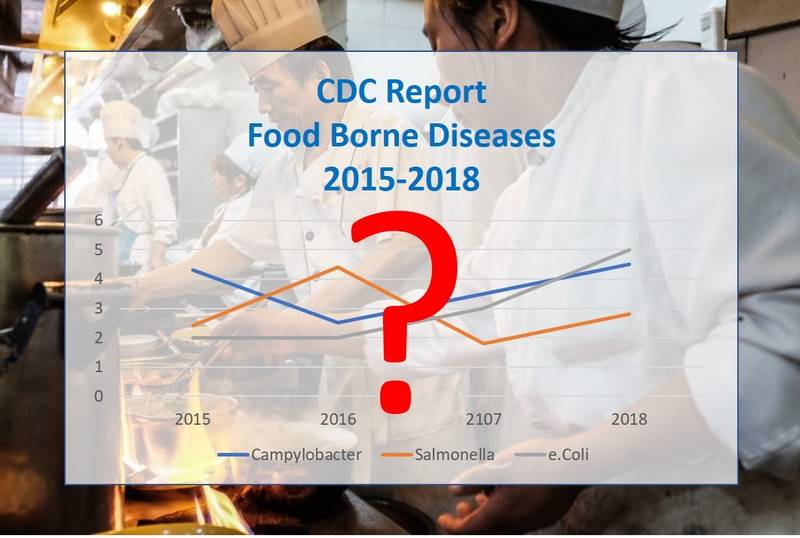
The bulk of this report discusses enteric infections, or food poisoning cases that affect the intestines. The two largest culprits discussed are campylobacter and salmonella infections. The CDC has confirmed nearly 10,000 infections of each in 2018. Following these two, e.Coli clocks in with nearly 3,000 cases, many of these coming from multiple outbreaks involving tainted romaine lettuce. This registers a 26-percent increase when compared to cases in 2015 to 2017.
Reading some of the discussions in this report indicate that the confirmed numbers are up partly due to improved testing methods. The CDC has increased the use culture-independent diagnostic tests, or CDITs, to diagnose suspected cases of enteric infections. This test is capable of identifying certain pathogens not routinely picked up by previously used testing methods.
While this report does have food-safety implications on a grand scale, what exactly does it mean to certified food managers?
We’ve drawn two conclusions from this report. First, improvements in testing technology show that illness from contaminated food is a larger issue than previous statistics have shown. This means that we should be more diligent then ever in promoting food safety in our establishments.
Finally, these advanced testing techniques have given us the most common pathogens and the food items that most commonly spread the infection. Seeing that there are targets the CDC has identified for improved food safety techniques gives us an insight into what types of ingredients require extra care. Certified food managers can be equipped with the knowledge that certain products are historically more susceptible than others and be diligent in inspecting shipments and following up on recalls and alerts concerning contaminated product.
Do statistics released by the CDC, USDA and other organizations have any effect on you handle food safety for susceptible products?